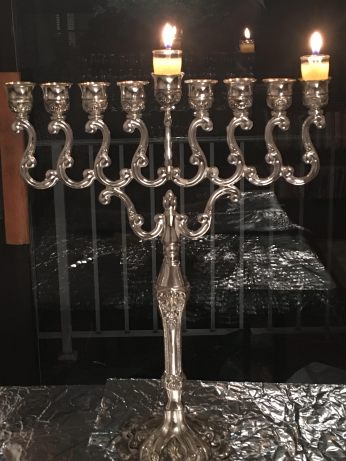
Chanukah 5778 – Part IV: Aharon HaKohen and Chanukah

The Torah reading for Chanukah comes from Sefer Bamidbar, and it describes the inauguration of the Mishkan and the offerings that each Nasi brought on behalf of their tribe. The connection between the two is that the laining for Chanukah commemorates the dedication of the Mishkan while the holiday we celebrate recognizes the re-dedication of the Bais HaMikdash after it was plundered by the Greeks. One can imagine the fanfare that came along with the joyous occasion of anointing the Mishkan for use. The excitement the nesiim exhibited must’ve been palpable, able to have been felt by all around. Yet, the commentators explain that there was one person who was a bit downtrodden by this momentous day: Aharon HaKohen.

Rashi quotes from the Midrash that when Aharon saw all the tribal heads bringing their offerings for sacrifice, he was disheartened and felt as if God did not desire his avodah nor the service of anyone else from his tribe in the chanukas haMishkan. In turn, Hashem responded to Aharon’s dejected state by telling him that his portion is greater than that of the Nesiim, as he will light the neros in the Mishkan twice a day, every day. This is why the two passages in the Torah are connected, as immediately sensing Aharon’s frustration at seeing the Nesiim bring their tribe’s korbanos, the next perek begins with Hashem commanding Aharon to light the lamps of the Menorah. Even though he wasn’t involved in this particular ceremony, Aharon’s role in the Mishkan of greater significance.

Ramban does not necessarily agree with this approach. There were a number of other things that Hashem could’ve consoled Aharon with instead of only the Menorah. What about the ketores that was brought twice a day, or the various daily korbanos brought by the Kohanim? What about the avodah on Yom Kippur, that only Aharon alone could perform or the ability to go in and out of the innermost sanctum of God? The entire nation of Kohanim are separate and holy from the rest of the Jewish people, and there are so many other ways that God could have soothed Aharon in the course of his discomfort.


Nachmanides continues that the reason that lighting the Menorah is what was used by Hashem to pacify Aharon was very specific. The lighting of the lamps in the Mishkan is an allusion to the lighting of the lamps that would take place during the second Temple period. This second lighting would be brought about by Aharon’s descendants. The Midrash concludes that when the Temple is not standing, none of the mitzvos pertaining to it are nullified. That includes the korbanos as well as lighting the Menorah. However, the lights that would be kindled as alluded to earlier were not only the ones lit in the Temple, but the ones that each and every Jew lights during Chanukah. The Beis HaMikdash may be non-extant, but the commandment to light our Chanukios each Chanukah is a mitzvah that applies even today.

Rabbi Soloveitchik sheds more light on this subject. Had it not been for the care and concern that Aharon and Shevet Levi showed for the Mishkan, who knows what state it would have been in for the dedication. He writes “today we celebrate Aharon’s Chanukah. Through him and because of him, the princes of today are able to stand up and stand out. What you do, Aharon, is greater than what they do.”

Aharon was sullen over not being able to participate in the chanukas haMishkan like the Nesiim were. Nevertheless, he, through his valiant descendants, merited greatness and an overarching impact that extended long past the destruction of the Temple.

Chanukah 5778 – Part III: A Time For Teshuva

IMG_0762.JPG

Chanukah is a festival that wears many hats, so to speak. It’s a holiday of light, miracles, Torah study, joy and more. There is no shortage of ideas that can be connected to Chanukah, and there is an interesting one put forth by Rabbi Yehuda Aryeh Leib Alter, the second Gerrer Rebbe also know as the Sfas Emes. Sfas Emes explains that Chanukah is a holiday of teshuva, returning and repenting to the Almighty. When we think of times on the Judaic calendar that are devoted to teshuva, most would respond that 10 times out of 10 the days that come to mind would be the Yamim Noraim. The very time between Rosh Hashannah and Yom Kippur is known as the ten days of repentance! What is the connection between Chanukah, almost months three months removed from the High Holidays, and teshuvah?

Sfas Emes explains that the Torah reading during the days of Chanukah comes from Bamidbar, when the heads of each tribe brought their identical, yet unique korbanos (more on that here!) as the Mishkan was being dedicated. Hakamas HaMishkan, the erecting of the holy Tabernacle, was a tremendous time for hashraas haShechina, the resting of God’s presence in the world. Hashem tells Moshe Rabbeinu “V’asu Li mikdash, veshachanti besocham,” that if you will build Me a sanctuary, I will dwell within it. Once the Mishkan is completed, the Shechina is there. Similarly, explains the Sfas Emes, that any time there is any sort of dedication like this, the Presence of God rests within the structure. Chanukah is no exception. Once the impurity of the Yevanim was removed, and the menorah was kindled once again, there was yet again purity in the Beis Hamikdash. As the ones who began the restoration of the Temple to the level that it had maintained previously, the Chashmonaim were considered to be tremendous baalei teshuva. We are taught that where baalei teshuva walk, even the most righteous individuals cannot stand. In turn, the Chashmonaim were blessed with an “or chadash,” a new light, as they lit the flames in the Temple with the one cruse of undefiled oil that they found amid the rubble. This new light was different and brighter than the light that existed previously, bringing about a rededication of the Beis HaMikdash.

Sfas Emes concludes that on Chanukah, in the wake of the teshuva of the Chashmonaim, the Divine gates of repentance are open, and the Ribono Shel Olam awaits our petitions. Let’s not let this time “burn out” without having made use of it.

Chanukah 5778 – Part II: Something, But Not Nothing

IMG_0759.JPG

We learn at the end of the second chapter of Pirkei Avos a poignant lesson about exerting effort in all that we do. “It is not incumbent upon you to complete the task, but neither are you free to desist from it.” In his commentary on the siddur, Rabbi Dr. Abraham J. Twerski writes that this missive is not only a wonderful life lesson, but an important note about the story of Chanukah.

Rabbi Twerski quotes from the Torah (Devarim 14:29) that in reference to the Jewish people, “God will bless you in all that you do.” It’s clear that we cannot do anything without assistance from Above. Nevertheless, Rabbi Twerski comments, that doesn’t give us license to set ourselves up for failure and expect success. For example, one cannot walk into an exam without having studied and rely simply on Hakadosh Baruch Hu to enlighten them with the correct answers. This is the precise message when it comes to the two miracles of Chanukah, defeating the Greeks in battle and the oil lasting for eight days.

The Chashmonaim saw what was occurring in their midst, and they didn’t sit around and wait. They fought valiantly, despite being their army being weaker and smaller in size. These were not fighters of great military prowess. They were “oskei sorasecha,” individuals who occupied themselves with the God’s Torah. What did they know about battle? Yet, they fought with all their strength, relying on the Almighty to aid them. They did not know if they would completely fail in their fight, yet fight they did.

The same can be said about the neis pach hashemen. We all know the story. The war had been won as the Chashmonaim ascended to attempt to light the Menorah. In the rubble, they only found one container of uncontaminated olive oil fit for use. A single jug of oil would typically only last for one day. What were they to do? Put yourself in their sandals for a moment. You could attempt to light on day one, and try and find more oil to last you throughout the layover. You use the oil that was not usable otherwise. You could divide the oil into separate parts until more would arrive, 8 days later. Alternatively, you could not light the Menorah at all until more oil was procured. The Jews used the only remaining oil they had left to sanctify the Menorah. They had to assume that it would be extinguished the next day. Yet, it was not. This scene repeated itself day after day after day, until finally, the pure oil made its way to them.

There are times in our lives when we may feel as if we are completely lacking and a sense of inertia comes over us. Is the effort we put into our routine really worth it if we’re not sure if we’ll succeed in our endeavors? The message of the Chashmonaim is a resounding yes. The message of the Chashmonaim tells us that our actions matter. For the Jews generations ago, their work was met with success, even though we know that this is not always the case.


Chanukah 5778 – Part I: The Light of Torah

unnamed.jpg

The holiday of Chanukah is a time to usher in a renewed spirit and energy to Torah study. We recite in Al HaNissim that the Greeks sought to cause the Jewish people to forget their Torah knowledge and have them veer from the will of the Ribono Shel Olam. There’s often a common misconception associated with the Chanukah in reference to outlook of the oppressors of the Jews. Namely, the Greeks did not wish for the wholesale eradication of the entire people like other tyrannical leaders or regimes. Rather, they sought to uproot any connection that Klal Yisrael had to the Torah and Hashem. Rabbi Dr. Abraham J. Twerski notes that the Jews would’ve been allowed to freely live as they pleased so long as they severed all ties they had with the Almighty. The war was a result of not willing to accept this ultimatum. As the military victory was a colossal triumph for the Chashmoniam, this was not a typical war that comes to mind, one for physical endurance: it was one of spiritual survival. Through the defeat of the Greeks, we as a people were able to continue living a life according the same statutes that they sought to destroy.

Thus, we have a mandate of increasing our ruchnius on Chanukah. We have eight days of mitzvos, additions to our daily tefilah, and an increased call to learn Torah. Rabbi Gavriel Zinner, in the introduction to his encyclopedic work Nitei Gavriel, underscores the importance limud haTorah being particularly relevant to learning while the flames are lit. Moreover, the quality of our learning will increase greatly, and we have the ability to better understand the meaning of the volumes we are poring over. He supports this idea from the Rabbi Yitzchak Meir Alter (founder of the Ger Chassidic dynasty, also known as the Chiddushei HaRim), who writes that this notion stems from the verse in Mishlei (6:23) “ki ner mitzvah v’Torah or” that a mitzvah is a candle and the Torah is light. Rav Zinner notes that through the “neros of mitzvah,” i.e. the Chanukah lights, we will be zoche to “Torah or,” a tremendous illumination of theTorah.

The Nitei Gavriel buttresses this idea with a statement of Rabbi Yisroel Hopstein, universally known as the Kozhnitzer Maggid. The Maggid explains that immediately after one davens, they should engage in Torah study, specifically in the areas that seem confusing, contradictory, and difficult for them to understand. This is because in our prayers say that “You graciously endow mankind with wisdom, and teach mortals insight.” We specifically thank God for giving us wisdom, and we finish this blessing by asking for more Divine assistance in this area. How could we not employ that which we have just asked for?

Through the “neros of mitzvah” we will bring about “Torah or.”

Vayeshev 5778 – The Transformation of Yehuda

Image result for crossroads

The next few parshios deal mainly with Yosef yet in Parshas Vayeshev we find a tremendously powerful detour to the life of his brother, Yehuda. This event probably leads the way in the “most-likely-event-to-have-not-been-taught-in-depth-or-even-at-all-in-day-school-or-elsewhere” award standings. The episode that I am referring to is the “encounter” between Yehuda and Tamar, which may have been how it was first explained to you had it been in a Bereishis or Parsha curriculum.

In the fourth aliyah, we read of Yehuda going off and getting married. He and his wife were blessed with three sons: Er, Onan, and Sheyla. Yehuda finds a wife for his eldest son named Tamar, yet Er is ultimately killed for being wicked. Yehuda summons his next son, Onan to marry Tamar, and who meets the same fate as his older brother after not wanting to sire her children. Tamar is relegated to waiting around for Sheyla to mature both in years, and according to the Chizkuni, in his behavior, to ensure that he does not wind up like his brothers.

Many days passed, the pasuk says, as Tamar sat and waited for the day that she would marry again. After the passing of Yehuda’s wife, he and Sheyla leave their home and set out for Timnah to watch over the flock of his friend Chira, in an effort (I assume) to clear his head from losing his beloved spouse. She hears Yehuda is making his way through where she was and goes out with her face covered to see him. As this occurs, she gets more than she bargains for as walking along with Yehuda is Sheyla, her purported husband-to-be, who had grown up significantly since their last interaction. Seeing her outside on the road, Yehuda thought she was a prostitute, and wished to avail himself of her services. He pledges to send over a goat from the flock, and the woman says that she needs collateral until that happens and asked for his cloak, signet, and staff. When he takes his leave and eventually sends the goat that he had promised, the shaliach that he sends to make the delivery cannot find the intended recipient. Even after asking around, there is no sign of the harlot that was once at the crossroads. Yehuda was confused, but moved on.

Three months later, Yehuda received word that his daughter-in-law Tamar was now pregnant, an act of “harlotry.” He is fuming, and says that she should be burned. After being brought to Yehuda’s house, Tamar explains that the father of her unborn child (spoiler alert: twins!) was the man to whom these items belong, and asks if he can identify the cloak, signet, and the staff. Yehuda, of course, recognizes all three.

Yehuda is in quite a predicament. He can say that these items are foreign to him, and let his daughter-in-law die for her “sin,” or he can make himself uncomfortable and vulnerable by telling the truth. Those items Tamar had with her were his, and he knew it. Which path does he choose?

Tzadka Mimeni. She is right, it is from me.

Rav Soloveitchik explains that this was the beginning of a transformation of Yehuda. This admission set in motion a series of events that removed the negative characteristics from within him that had overcome him during the sale of Yosef. It was Yehuda who convinced the band of brothers to sell their brother, the dreamer. Rashi explains that when the brothers saw how much pain the sale of Yosef caused their father, they immediately regretted the transaction and were furious with Yehuda. The passage relating to Yehuda getting married until this point began with the pasuk telling us that Yehuda went away from his brothers. He had to get away! The Rav notes that this portion of his life had now broken away from him in the aftermath of Tamar’s revelation. It was only after this that Yehuda became the great leader that we now consider him to be, the one who the Mechilta says will have the kings of Israel be from his progeny. Furthermore, says the Rav, this entire episode teaches us a tremendous lesson in teshuva. We know Yehuda later offered himself as a slave in place of Binyamin to placate Yosef, then a distinguished leader, and the brother that he once arranged to sell. It is not through the line of Yosef that Mashiach will eventually redeem the Jewish people to Jerusalem. Yosef was on an elevated level of tzidkus his entire life. Mashiach will come through Yehuda, from one who did teshuva gemura, and changed the course of their entire existence.

There is a tremendous lesson to be learned here from the actions of Yehuda. It’s so easy to get defensive when someone has a claim against us or something we’ve done. We want to rationalize, we want to defend. Even when we do apologize, do we mean it? Do we say “I’m sorry that I’ve hurt you, and I’d like to make it up to you?” or do we offer a pithy “I’m sorry you’re offended by what I did” and move on? From the text, we can make a clear argument for Yehuda.

“I thought you were someone else!”

“You know, YOU didn’t say anything and you knew it was me! Why didn’t you say anything?”

“If I knew it was you, I would’ve never done this!”

But statements like these are not what Yehuda says to defend himself. He doesn’t. She is right, it is from me. We see that Yehuda changes from the outcast brother that runs away from the family out of shame to the prince of the family, who will ultimately have the Divine emissary of redemption stem from his lineage. We too, have the ability to make these strides, although they can be extremely hard to implement when need be.


Vayishlach 5778 – I Have Everything

Image result for farm

In Parshas Vayishlach, we read about the impending meeting of Yaakov and Esav. It was a family reunion of sorts, having not seen each other in quite some time. Yaakov is gripped with fear about seeing his brother and sent malachim to Esav to gauge his mood. The malachim return to him and report that Esav is on his way, and he has 400 men in tow. Yaakov is petrified, but Hashem assures him that all will be fine. When they finally meet, their sophomoric, brotherly squabbles seem to have subsided because they embrace each other and cry. The 400 men that had come along with Esav had dispersed. Yaakov prepares an impressive goodie bag for his brother Esav, in order to please him so he won’t want to kill him. When we last saw these two characters interacting with each other, Esav was planning to kill his twin brother after he cunningly and craftily “stole” the bechora away. When they meet, Esav tells Yaakov to take back his gift because “Yesh li rav”/I have plenty.” Rashi comments that Esav had more than he’d ever need. Yaakov responds to him “take the gift which has been been brought to you because Hashem has shown grace and I have everything.” Esav acquiesced, and kept what had been given to him by his brother. Rav Shlomo Wolbe in his monumental work, Alei Shur, has a fascinating insight on what has just transpired. Esav, whose entire life was steeped in materialism, only allowed himself to say that he has plenty. Rav Wolbe mentions that despite such a person continuously gaining more and more, they will never feel that they have enough. There is always more to obtain. This echoes a sentiment by our sages, who tell us that a person who has one hundred, always wants two hundred. Similarly, the Midrash in Koheles Rabbah points out that a person doesn’t leave this world with even half of what they desire!

On the other hand, we have Yaakov Avinu who was not only completely satisfied with what he had, but had no interest in amassing more possessions. That is the reason that he is able to state “I have everything.” If one’s frame of mind is “I have 100 but I want 200,” they’ll continue to want, and their lust will not be satisfied. Yet, if one employs the approach of Yaakov, “I have 100 and I will make do with 100,” they will be blessed. This is a fundamental point in the difference between the words of Yaakov and the words of Esav, having it all versus having all I need.

Rav Wolbe continues in Alei Shur with a Gemara in Bava Basra (16b) tells us that three people were given a taste of Olam Haba while still in Olam Hazeh: Avraham, Yitzchak, and Yaakov. For what did Yaakov Avinu merit this? The Gemara explains that is because of our very pasuk: Yeish Li Kol. Yaakov Avinu realized that he has everything he needs. This, says Rav Wolbe is something we can incorporate into our everyday lives as well. Every morning, we thank Hashem and recite the bracha of “she’asa li kol tzorki” for providing for all of our needs.

A few years ago, there was a fascinating article that circulated around the internet about a former NFL football player named Jason Brown. Brown was drafted by the Baltimore Ravens (boo) and played there for a few years before moving to the St. Louis Rams, and played relatively well. When his contract expired in 2012, Brown’s agent was fielding offers from numerous teams interested in signing him. He had a $37.5 million contract ready to be signed and he walked away from it. Jason Brown bought a 1000 acre farm in North Carolina, and with the help of some agricultural geniuses, now owns and operates the First Fruits Farm. Brown’s farm is more than about sustaining himself and his family, and as the name entails, he gives his first fruits to charity (and then some). Brown said that while it was a lot of money to be left on the table, the money is not what’s important. He more than enough to live on and took from what he had and gave back, and continues to feed the needy all over his state. Sure, he had already gotten plenty of paychecks, and his circumstances are different than most of ours. Nevertheless, it’s still a message that we can internalize. Let us live our lives in the same way, the way as prescribed in the Pirkei Avos. The Mishnah states “Eizehu ashir hasomeyach bechelko/Who is rich? one who is happy with his lot.” One who is truly wealthy looks around at their life and says I have everything I need (that doesn’t mean that we would be unhappy with more, but we make do with what we have). We must take the mahalach of Yaakov Avinu and be thankful for what we are blessed with, and try not to yearn for things that we do not.

VaYeitzei 5778 – More Than We Deserve

USA_Thanksgiving_1920_800.jpg

In Parshas Vayeitzei we are introduced to Yaakov’s quickly blossoming family. In pasuk after pasuk we read about his children being born. The way that Leah chooses to name her children is interesting, to put it one way. Leah is the elder sister of Rachel, the woman whom Yaakov worked for years to be able to marry. Yet, in a dastardly act of deception, his future father-in-law calls and audible, and Yaakov is left married to Leah instead of his beloved Rachel. In the aftermath of this debacle, Yaakov agrees to continue working for Lavan in order to marry Rachel. One can only imagine how this makes Leah feel, and it’s manifested in the way she names their children. She conceives quickly, as the verse states, because Hashem blessed her after seeing how she was “hated” by her husband.

And Leah conceived and bore a son, and she named him Reuven, for she said, “Because the Lord has seen my affliction, for now my husband will love me.

And she conceived again and bore a son, and she said, “Since the Lord has heard that I am hated, He gave me this one too.” So she named him Shimon.

And she conceived again and bore a son, and she said, “Now this time my husband will be attached to me, for I have borne him three sons; therefore, He named him Levi.

She then gives birth to Yehuda and something changes.

And she conceived again and bore a son, and she said, “This time, I will thank the Lord! Therefore, she named him Judah, and [then] she stopped bearing.

This time, Leah thanks God, “hapaam odeh es Hashem.” Rashi helps us understand the background. He writes that each of our matriarchs had nevuah and they knew that Yaakov Avinu would have 12 tribes that descended from him. They also knew that there were four wives, so it would make sense that each one would have three. Yet, it is Leah, the “hated” wife of Yaakov who bears the most of his children, more than his other wives combined. When Leah gives birth to Yehuda, she is so thankful that there is something unique about her, something that may enhance her connection with her husband. Rashi comments here that she thanks Hashem in this instance since she has taken up more than her share by having a fourth son, shifting the equal divide from the other wives of Jacob.

Rabbi Yitzchak Meir Alter of Ger, the Chidushei HaRim, explains this notion even further. Leah thanked Hashem because she received more than what she was expecting, more than she “deserved.” For this reason, the Gerrer Rebbe points out, is exactly why we are called Yehudim, for we too “take” more than we deserve. It’s incumbent upon us to thank God for what He gives to us as if we’re not worthy of receiving it. As we are not neviim, we are not granted special knowledge of what is ra’ui for us to receive and what is not. Yet, God continues to provide for us and implement His wisdom in our lives every day.

This is the message of Leah Imeinu. Leah recognized that she was indeed blessed, and that by being granted another son, she was almost not worthy of the gift that she received. She portrays her thanks to the Almighty by naming her fourth son, not only recognizing her gratitude for his birth when she bore him, but forever more by calling him by that name. I think this may be why she ultimately merited to have three other children. Leah’s relationship with Yaakov may have been frustrating enough that she felt undesired and snubbed by her spouse, but she teaches us a tremendous lesson in gratitude.

Toldos 5778 – Yitzchak’s Vision: What Could Have Been

Image result for lentil soup

In Parshas Toldos, we are first introduced to Yaakov and Esav. Their struggle with each other began even before their birth, as they pained their mother Rivka while still in her womb. At the beginning of the parsha, before we really even know a great deal about the twins, the pasuk states that Yitzchak loved Esav and that Rivka loved Yaakov. That’s not to say that each parent didn’t love the other child as well, but the Torah emphasizes that Yitzchak had an affinity to Esav, while Rivka had an affinity to Yaakov. From a young age, we are taught the events that follow between Yaakov and Esav. Esav returns home rather peckish after a strenuous day in the field. His younger brother was in the kitchen preparing food, which enticed him tremendously. Yaakov, as we know, only acquiesces to feed his brother on the condition that he, the younger brother, receive the Bechora blessing from their father. A strange trade off, no? Esav, as ravenously hungry as he was, agrees to these terms, and the deal is done.

I have always been curious as to why Yitzchak felt more of a connection to Esav than he did to Yaakov. Didn’t he know Esav was a rasha and Yaakov was a tzaddik? He wasn’t a random passerby who didn’t know the stories of the brothers and what they were doing with their lives. He’s their father! Even though Esav is the elder of the two, Yitzchak could’ve given Yaakov the blessing and blessed Esav with something else, which he ultimately did anyway!

So why did Yitzchak want to give the bracha of Bechora to Esav? Surely Yitzchak knew that Yaakov was an “ish tam” and that Esav was “yodeah tzayid.” The Chasam Sofer’s take on this conundrum is one that I found very interesting. He posits that Yitzchak had envisioned a grand partnership between the twins. In his mind, Esav and Yaakov were supposed to function like Yissachar and Zevulun. Yaakov would learn and support Esav spiritually and Esav would support Yaakov’s needs. It was precisely for this reason that despite Yaakov trading for the Bechora and being more righteous than his brother, Yitzchak was so intent on giving Esav the Bechora. Yitzchak Avinu still held to the belief that this model of working together could be achieved. The blessing given states that Hashem should give him from the dew of the Heavens and the fat of the land, while also being privy to an abundance of grain and wine. This was all supposed to go to Esav in order to support himself as well as Yaakov. While Esav is indeed blessed in the Parsha, he did not receive the Bechora, the blessing he traded away so eagerly yet eventually came to cash in on.

It’s written in Tehillim (133) “Hinei mah tov umah naim sheves achim gam yachad. How good and how pleasant it is, brothers sitting together.” (It was actually written by David HaMelech before it was a Miami Boys Choir song…). Rivka may have known that this was not to be, and sent Yaakov away as soon as he was blessed with the Bechora. But for Yitzchak, it was a dream that he still held onto of what could have been.

19 Cheshvan 5778 – All Of Them Equally Good


Parshas Chayei Sarah opens:  וַיִּֽהְיוּ֙ חַיֵּ֣י שָׂרָ֔ה מֵאָ֥ה שָׁנָ֛ה וְעֶשְׂרִ֥ים שָׁנָ֖ה וְשֶׁ֣בַע שָׁנִ֑ים שְׁנֵ֖י חַיֵּ֥י שָׂרָֽה And the life of Sarah was one hundred years and twenty years and seven years; [these were] the years of the life of Sarah. Our matriarch Sarah meets her demise at the ripe old age of 127, leaving Avraham and Yitzchak to mourn her. There is a tremendous amount of commentary on the inaugural pasuk of the Sedrah, especially when it comes to how the years of Sarah’s are each separately listed. Rashi comments on the last three words of the pasuk that of these 127 years, “kulan shavin letovah,” that all of them were equally good. The first time I encountered this interpretation of the prolific commentator, I was puzzled and read it again.

All of them equally good.

Let’s go over some of the things we learn about Sarah Imeinu in the few prakim that she is alive in the Torah. We first meet Sarah as Sarai, the wife of Avram, when they pick up their entire existence in Charan and relocate. The exact destination to where they are moving is still a mystery to them. Nevertheless, this sanctified voyage is commanded by God, and one could assume that, as such, Avraham and Sarah would not be met with any trials and tribulations on their trail.

Not exactly.

As they travel along, they are met with a famine, something that we (thankfully) cannot comprehend today. Sarai is then taken captive into the harem of of Pharaoh while in Egypt looking for food. We next encounter Avraham and Sarah’s struggle to conceive, an experience of immense pain and disappointment. Her hurt is augmented as she gives her handmaid to her beloved husband to produce a child. As if on cue, Hagar quickly becomes pregnant and gives birth to a son. She later watches as her husband rushes to greet guests and welcome them into their home. They tell her that she will be blessed with a child, and she laughs, a blessing she may have thought about or been given for years without coming to fruition. She is chastised for having laughed by the Almighty, although on some level, I can understand why she did. Miraculously, she does indeed become pregnant, and gives birth to a son. Yet, even then, she is still bothered by the presence of Hagar, and beseeches Avraham to send her and Yishmael away. Once they are banished, to top it all off, we have Akeidas Yitzchak, where the precious child that she had prayed and hoped for, the apple of her eye, was about to be slaughtered like a korban.

Hakol shavin letovah.

The years were equally good. To even the most novice reader, most of what we know of Sarah Imeinu’s existence is negative. She’s only around for a few parshios, and there is so much pain lying in the verses as they tell her tale. Reading about such events can evoke sympathy. Still, I can only imagine the agony she felt that we don’t know about. Armed with what we know from the psukim, how can Rashi possibly think that the years of Sarah were all considered good?

As I mulled over potential answers to this conundrum, I realized that I actually had an idea of just how it was possible. It’s an idea that was mentioned more eloquently in a shiur by Rabbi Shalom Rosner. He explains so poignantly that there are both high points and low points, but the hashkafa, the view that we employ on these events is crucial. There are times in our lives which are filled with sorrow. When looking back on these moments many years later, we may gloss over the exact feelings we exhibited previously, as the wounds are no longer fresh. The process of recognizing the blessing that our lives are endowed with even lends itself to the times when we may have been at our saddest or our lowest. True, those occasions are vividly raw, far from being considered good. Yet, at the end of one’s life when they look back at their days, more often than not, there is an abundance of good that shines through despite the heartache that exists.

I was fortunate that I had someone in my life that didn’t talk about living like this. Rather, this was the way that she lived her life. .

The Radman and Balk families would be the first to tell you, even before her doctors, that my mother did not always have the easiest life. She was afflicted with various illnesses for the majority of her time in olam hazeh. I rack my brain to try and remember her as she was in the times when she wasn’t sick. No matter what ailed her or kept her cooped up in the hospital, her spirit and attitude were the same as when she was out doing the things that she loved. The things that imbued her life, and the lives of those around her, with significant meaning. Her days were not always easy, but my mother’s simchas hachaim, her joie de vivre, made those around her feel as if there was nothing in the world that was bothering her. She may have been the one with an suppressed immune system, yet it was those around her who contracted her highly-contagious positivity and zest for life. Even in her final days.

Capture111.PNGThere’s one particular time in my life when this missive of being able to reflect on the positive among the negative hit home in a way that it hadn’t before. It was a summer that I otherwise would’ve cared to forget, as my mother was in the midst of a months-long stint in her home away from home, the Cleveland Clinic. She was given a palatial private room that I was sure was only reserved for foreign royalty who required medical care. It was a corner room, where we’d watch the Life Flight helicopters take off and land, and see three different sets of fireworks on the Fourth of July. It was one of the hardest summers. Maybe for her, but definitely for me. Dena and I were both taking classes that summer, sharing the car and planning out our schedules to maximize our time with Mom. My mother’s excellent medical team was baffled as to why her blood levels were low, and why she needed so many blood transfusions. It was eventually determined that an enlarged spleen was the culprit. A regular spleen weighs about a pound. Hers was pushing 10 times the size of that. My mother was overjoyed that her doctors figured out what was wrong, not to mention the fact that that she’d be looking particularly svelt after her 10 lb. spleen would be extracted. During surgery to remove the organ, one of the doctors had accidentally nicked a bowel, a virtually undetected mishap. It was discovered days after the operation, only after my mother’s attentive nurse wondered why there were little pieces of food she had recently eaten in the output in a drain of incision site. She was relegated to a liquid diet, which she abhorred, until the issue was ultimately resolved. As I watched this all unfold, I felt as if I was even more angry than she was over the ordeal.

There was one particular day when it was just my mother and me in her room. She was most likely watching The Barefoot Contessa or What Not To Wear, while I was trying hard to not be overly frustrated about her television choices. I opened up to her about my frustration in regard to her medical situation and how this entire episode should’ve been avoided. She quickly and assertively told me that I shouldn’t think that way. I pressed further and noted that due to the mistake during surgery, she had the makings of a lawsuit against the doctors, one that could’ve likely been successful in her favor. Almost as quickly as I got the words out of my mouth, she shot my statements down. Very matter-of-factly, without raising her voice, she looked me dead in the eye and said: “Why would I do anything to them? They saved my life–I wouldn’t be here without them!” I’m not sure what followed in the immediate aftermath, but I assume she turned back to the TV or to her Kindle, while I was left completely quashed. That was that. This wasn’t a claim she made to merely pacify herself in her predicament, or even part of a facade that she employed when speaking to others. It’s truly how she felt, and it’s how she comported herself until she took her final breaths.

We will all undoubtedly face moments that stop us dead in our tracks with grief. Each and every one of us. As we reflect on our lives as we age, may we be zoche to look back and consider our years to have been equally good ones. That’s the message of Sarah Imeinu, and it’s a message, among a litany,  that I learned from my mother. The bottom of her headstone is emblazoned with the end of a verse from Mishlei that is sung as part of Eishes Chayil. “Vatischak leyom acharon.” My mother was able to laugh and smile in her final time on earth because she could look back and recall her time here as explicitly good. That doesn’t mean for a moment that there were no setbacks or things she may have wished went differently. There were many. Despite them, she remained joyful to the end.

This year marks the 4th since she passed away. The 4 years of not being able to see her or have a conversation with her physically feel longer than the 24 that I was lucky to have the privilege to do that. As the 19th of Cheshvan comes and goes, I try this year to look back and consider the years without her as equally good as the ones that I spent with her. I’m not quite there yet.

Vayera 5778 – Accomplishing Failure

Image result for donkey mountain

Parshas Vayera is absolutely brimming with action and the Shemen Hatov connects three significant points from the sedrah. 

The Torah portion opens as Avraham is convalescing from his bris milah in his tent in extreme heat. Rashi explains that this was the third day after Avraham’s circumcision, the most painful in the recovery process. Rashi also notes that when the pasuk mentions that the day was hot, this is not a mere trivial piece of information. Hashem had made it specifically hotter on that day in order to deter any passersby from wandering close to him, because Avraham would surely get up and bring them into his home. Yet, it was neither the heat nor the recuperation that bothered Avraham on that day. He was downtrodden at the prospect of their being no guests for him to feed and take care of. Ultimately, three guests do arrive, and they give Avraham and Sarah the news that they will soon be blessed with a child. But, Rashi explains that they Malachim do not eat.  

Immediately after the Malachim come to Avraham, God informs him that the city of Sdom has grown rife with sin and will be destroyed. While one might’ve intuited that as a loyal subject, Avraham would accept this Divine decree, the decimation of this wayward city does not sit well with him. He pleads with the Almighty – must You punish the righteous together with the wicked? The shakla v’tarya continues between Hashem and Avraham, to not destroy Sdom even if there are 50 tzaddikim in the bustling metropolis. Rashi explains Sdom was broken up into 5 areas, which corresponded to 10 tzaddikim per each. Then, Avraham’s claim drops down to 45 tzaddikim total. Then 40. 30. 20. Finally, 10. But it was not to be, and Sdom and its capricious inhabitants were doomed to eradication.

Finally, Hashem gives Avraham his hardest nisayon to date: sacrificing his beloved son, Yitzchak. Yet, when the command comes, the psukim do not mention any complaints or backlash from Avraham. He awoke early to do the will of God. He and Yitzchak were atop Har HaMoriah ready to make the sacrifice. Yitzchak, sheepishly (one could assume) says, “we’ve got almost everything we need, but where’s the lamb that we’ll be sacrificing?” That seems like it would be a seminal part of the entire trip. Avraham reassures his son that God will provide the animal, don’t worry (hard not to worry when your father then begins to bind you to the sacrificial altar…). As Avraham is about to complete the act, a Heavenly voice calls out to Avraham and tells him to not harm Yitzchak. Avraham noticed a ram with its horns stuck in a tree, and offered it as a korban in Yitzchak’s place.

We look back at Avraham’s pursuit of Hachnasas Orchim, wanting to save the wanton city of Sdom, and the Akeidah and we marvel at the courage and strength of our pious patriarch. Yet, from a success standpoint, what exactly did Avraham Avinu accomplish? Avraham essentially “fails” in each of his endeavors. The Malachim come to him, and he has Sarah prepare a lavish meal as a measure of Hachnasas Orchim. However, even though we hereafter are commanded to welcome guests in our midst based upon laws that stem back to this very encounter, the Malachim don’t really eat anything from the spread. Next, Avraham pleads with Hashem to save the city of Sdom from destruction. Ultimately, as we know, his pleas fall short. Finally, Avraham Avinu musters up the courage to sacrifice his own beloved son. As he’s about to do this act, he’s called out to and told not to harm Yitzchak, eventually sacrificing a ram in his son’s place. Three unique events, all met with failure. Nevertheless, we still think of these events unique events that make Avraham a special person. He set out to accomplish something, put in significant effort, but nonetheless fell short.

We learn from these experiences a very valuable lesson for our own lives. There are times when we too, go through painstaking effort in order to make something happen. There are times when our effort is met with success. At other junctures, it seems our toiling was all for naught, even if we invest more of our time and resources in the moments of failure than the moments of success. But even at times where we fall short, we have reason to keep our heads up. Avraham does not grow frustrated with his efforts not having been met with his desired result. There is no deathbed confession from Avraham at the end of his life stating any remorse or regret for not having been able to do this mitzvah, nor does he cast God away from his life. When these pitfalls do occur, they can be painful and frustrating. Avraham did everything in his power to make his desires come to fruition. Despite his great ingenuity, he did not attain what he set out to achieve. It doesn’t seem confusing to recognize these moments in Avraham’s life. The relationship between Avraham and Hashem after these events continues to grow stronger and stronger. May our individual relationships with the Ribono Shel Olam continue to do the same.