Chanukah 5778 – Part II: Something, But Not Nothing

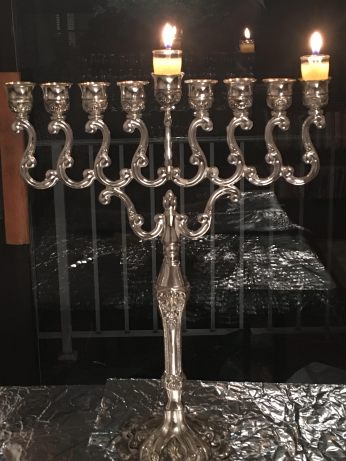
IMG_0759.JPG

We learn at the end of the second chapter of Pirkei Avos a poignant lesson about exerting effort in all that we do. “It is not incumbent upon you to complete the task, but neither are you free to desist from it.” In his commentary on the siddur, Rabbi Dr. Abraham J. Twerski writes that this missive is not only a wonderful life lesson, but an important note about the story of Chanukah.

Rabbi Twerski quotes from the Torah (Devarim 14:29) that in reference to the Jewish people, “God will bless you in all that you do.” It’s clear that we cannot do anything without assistance from Above. Nevertheless, Rabbi Twerski comments, that doesn’t give us license to set ourselves up for failure and expect success. For example, one cannot walk into an exam without having studied and rely simply on Hakadosh Baruch Hu to enlighten them with the correct answers. This is the precise message when it comes to the two miracles of Chanukah, defeating the Greeks in battle and the oil lasting for eight days.

The Chashmonaim saw what was occurring in their midst, and they didn’t sit around and wait. They fought valiantly, despite being their army being weaker and smaller in size. These were not fighters of great military prowess. They were “oskei sorasecha,” individuals who occupied themselves with the God’s Torah. What did they know about battle? Yet, they fought with all their strength, relying on the Almighty to aid them. They did not know if they would completely fail in their fight, yet fight they did.

The same can be said about the neis pach hashemen. We all know the story. The war had been won as the Chashmonaim ascended to attempt to light the Menorah. In the rubble, they only found one container of uncontaminated olive oil fit for use. A single jug of oil would typically only last for one day. What were they to do? Put yourself in their sandals for a moment. You could attempt to light on day one, and try and find more oil to last you throughout the layover. You use the oil that was not usable otherwise. You could divide the oil into separate parts until more would arrive, 8 days later. Alternatively, you could not light the Menorah at all until more oil was procured. The Jews used the only remaining oil they had left to sanctify the Menorah. They had to assume that it would be extinguished the next day. Yet, it was not. This scene repeated itself day after day after day, until finally, the pure oil made its way to them.

There are times in our lives when we may feel as if we are completely lacking and a sense of inertia comes over us. Is the effort we put into our routine really worth it if we’re not sure if we’ll succeed in our endeavors? The message of the Chashmonaim is a resounding yes. The message of the Chashmonaim tells us that our actions matter. For the Jews generations ago, their work was met with success, even though we know that this is not always the case.

 

Chanukah 5778 – Part I: The Light of Torah

unnamed.jpg

The holiday of Chanukah is a time to usher in a renewed spirit and energy to Torah study. We recite in Al HaNissim that the Greeks sought to cause the Jewish people to forget their Torah knowledge and have them veer from the will of the Ribono Shel Olam. There’s often a common misconception associated with the Chanukah in reference to outlook of the oppressors of the Jews. Namely, the Greeks did not wish for the wholesale eradication of the entire people like other tyrannical leaders or regimes. Rather, they sought to uproot any connection that Klal Yisrael had to the Torah and Hashem. Rabbi Dr. Abraham J. Twerski notes that the Jews would’ve been allowed to freely live as they pleased so long as they severed all ties they had with the Almighty. The war was a result of not willing to accept this ultimatum. As the military victory was a colossal triumph for the Chashmoniam, this was not a typical war that comes to mind, one for physical endurance: it was one of spiritual survival. Through the defeat of the Greeks, we as a people were able to continue living a life according the same statutes that they sought to destroy.

Thus, we have a mandate of increasing our ruchnius on Chanukah. We have eight days of mitzvos, additions to our daily tefilah, and an increased call to learn Torah. Rabbi Gavriel Zinner, in the introduction to his encyclopedic work Nitei Gavriel, underscores the importance limud haTorah being particularly relevant to learning while the flames are lit. Moreover, the quality of our learning will increase greatly, and we have the ability to better understand the meaning of the volumes we are poring over. He supports this idea from the Rabbi Yitzchak Meir Alter (founder of the Ger Chassidic dynasty, also known as the Chiddushei HaRim), who writes that this notion stems from the verse in Mishlei (6:23) “ki ner mitzvah v’Torah or” that a mitzvah is a candle and the Torah is light. Rav Zinner notes that through the “neros of mitzvah,” i.e. the Chanukah lights, we will be zoche to “Torah or,” a tremendous illumination of theTorah.

The Nitei Gavriel buttresses this idea with a statement of Rabbi Yisroel Hopstein, universally known as the Kozhnitzer Maggid. The Maggid explains that immediately after one davens, they should engage in Torah study, specifically in the areas that seem confusing, contradictory, and difficult for them to understand. This is because in our prayers say that “You graciously endow mankind with wisdom, and teach mortals insight.” We specifically thank God for giving us wisdom, and we finish this blessing by asking for more Divine assistance in this area. How could we not employ that which we have just asked for?

Through the “neros of mitzvah” we will bring about “Torah or.”

Vayeshev 5778 – The Transformation of Yehuda

Image result for crossroads

The next few parshios deal mainly with Yosef yet in Parshas Vayeshev we find a tremendously powerful detour to the life of his brother, Yehuda. This event probably leads the way in the “most-likely-event-to-have-not-been-taught-in-depth-or-even-at-all-in-day-school-or-elsewhere” award standings. The episode that I am referring to is the “encounter” between Yehuda and Tamar, which may have been how it was first explained to you had it been in a Bereishis or Parsha curriculum.

In the fourth aliyah, we read of Yehuda going off and getting married. He and his wife were blessed with three sons: Er, Onan, and Sheyla. Yehuda finds a wife for his eldest son named Tamar, yet Er is ultimately killed for being wicked. Yehuda summons his next son, Onan to marry Tamar, and who meets the same fate as his older brother after not wanting to sire her children. Tamar is relegated to waiting around for Sheyla to mature both in years, and according to the Chizkuni, in his behavior, to ensure that he does not wind up like his brothers.

Many days passed, the pasuk says, as Tamar sat and waited for the day that she would marry again. After the passing of Yehuda’s wife, he and Sheyla leave their home and set out for Timnah to watch over the flock of his friend Chira, in an effort (I assume) to clear his head from losing his beloved spouse. She hears Yehuda is making his way through where she was and goes out with her face covered to see him. As this occurs, she gets more than she bargains for as walking along with Yehuda is Sheyla, her purported husband-to-be, who had grown up significantly since their last interaction. Seeing her outside on the road, Yehuda thought she was a prostitute, and wished to avail himself of her services. He pledges to send over a goat from the flock, and the woman says that she needs collateral until that happens and asked for his cloak, signet, and staff. When he takes his leave and eventually sends the goat that he had promised, the shaliach that he sends to make the delivery cannot find the intended recipient. Even after asking around, there is no sign of the harlot that was once at the crossroads. Yehuda was confused, but moved on.

Three months later, Yehuda received word that his daughter-in-law Tamar was now pregnant, an act of “harlotry.” He is fuming, and says that she should be burned. After being brought to Yehuda’s house, Tamar explains that the father of her unborn child (spoiler alert: twins!) was the man to whom these items belong, and asks if he can identify the cloak, signet, and the staff. Yehuda, of course, recognizes all three.

Yehuda is in quite a predicament. He can say that these items are foreign to him, and let his daughter-in-law die for her “sin,” or he can make himself uncomfortable and vulnerable by telling the truth. Those items Tamar had with her were his, and he knew it. Which path does he choose?

Tzadka Mimeni. She is right, it is from me.

Rav Soloveitchik explains that this was the beginning of a transformation of Yehuda. This admission set in motion a series of events that removed the negative characteristics from within him that had overcome him during the sale of Yosef. It was Yehuda who convinced the band of brothers to sell their brother, the dreamer. Rashi explains that when the brothers saw how much pain the sale of Yosef caused their father, they immediately regretted the transaction and were furious with Yehuda. The passage relating to Yehuda getting married until this point began with the pasuk telling us that Yehuda went away from his brothers. He had to get away! The Rav notes that this portion of his life had now broken away from him in the aftermath of Tamar’s revelation. It was only after this that Yehuda became the great leader that we now consider him to be, the one who the Mechilta says will have the kings of Israel be from his progeny. Furthermore, says the Rav, this entire episode teaches us a tremendous lesson in teshuva. We know Yehuda later offered himself as a slave in place of Binyamin to placate Yosef, then a distinguished leader, and the brother that he once arranged to sell. It is not through the line of Yosef that Mashiach will eventually redeem the Jewish people to Jerusalem. Yosef was on an elevated level of tzidkus his entire life. Mashiach will come through Yehuda, from one who did teshuva gemura, and changed the course of their entire existence.

There is a tremendous lesson to be learned here from the actions of Yehuda. It’s so easy to get defensive when someone has a claim against us or something we’ve done. We want to rationalize, we want to defend. Even when we do apologize, do we mean it? Do we say “I’m sorry that I’ve hurt you, and I’d like to make it up to you?” or do we offer a pithy “I’m sorry you’re offended by what I did” and move on? From the text, we can make a clear argument for Yehuda.

“I thought you were someone else!”

“You know, YOU didn’t say anything and you knew it was me! Why didn’t you say anything?”

“If I knew it was you, I would’ve never done this!”

But statements like these are not what Yehuda says to defend himself. He doesn’t. She is right, it is from me. We see that Yehuda changes from the outcast brother that runs away from the family out of shame to the prince of the family, who will ultimately have the Divine emissary of redemption stem from his lineage. We too, have the ability to make these strides, although they can be extremely hard to implement when need be.


Vayishlach 5778 – I Have Everything

Image result for farm

In Parshas Vayishlach, we read about the impending meeting of Yaakov and Esav. It was a family reunion of sorts, having not seen each other in quite some time. Yaakov is gripped with fear about seeing his brother and sent malachim to Esav to gauge his mood. The malachim return to him and report that Esav is on his way, and he has 400 men in tow. Yaakov is petrified, but Hashem assures him that all will be fine. When they finally meet, their sophomoric, brotherly squabbles seem to have subsided because they embrace each other and cry. The 400 men that had come along with Esav had dispersed. Yaakov prepares an impressive goodie bag for his brother Esav, in order to please him so he won’t want to kill him. When we last saw these two characters interacting with each other, Esav was planning to kill his twin brother after he cunningly and craftily “stole” the bechora away. When they meet, Esav tells Yaakov to take back his gift because “Yesh li rav”/I have plenty.” Rashi comments that Esav had more than he’d ever need. Yaakov responds to him “take the gift which has been been brought to you because Hashem has shown grace and I have everything.” Esav acquiesced, and kept what had been given to him by his brother. Rav Shlomo Wolbe in his monumental work, Alei Shur, has a fascinating insight on what has just transpired. Esav, whose entire life was steeped in materialism, only allowed himself to say that he has plenty. Rav Wolbe mentions that despite such a person continuously gaining more and more, they will never feel that they have enough. There is always more to obtain. This echoes a sentiment by our sages, who tell us that a person who has one hundred, always wants two hundred. Similarly, the Midrash in Koheles Rabbah points out that a person doesn’t leave this world with even half of what they desire!

On the other hand, we have Yaakov Avinu who was not only completely satisfied with what he had, but had no interest in amassing more possessions. That is the reason that he is able to state “I have everything.” If one’s frame of mind is “I have 100 but I want 200,” they’ll continue to want, and their lust will not be satisfied. Yet, if one employs the approach of Yaakov, “I have 100 and I will make do with 100,” they will be blessed. This is a fundamental point in the difference between the words of Yaakov and the words of Esav, having it all versus having all I need.

Rav Wolbe continues in Alei Shur with a Gemara in Bava Basra (16b) tells us that three people were given a taste of Olam Haba while still in Olam Hazeh: Avraham, Yitzchak, and Yaakov. For what did Yaakov Avinu merit this? The Gemara explains that is because of our very pasuk: Yeish Li Kol. Yaakov Avinu realized that he has everything he needs. This, says Rav Wolbe is something we can incorporate into our everyday lives as well. Every morning, we thank Hashem and recite the bracha of “she’asa li kol tzorki” for providing for all of our needs.

A few years ago, there was a fascinating article that circulated around the internet about a former NFL football player named Jason Brown. Brown was drafted by the Baltimore Ravens (boo) and played there for a few years before moving to the St. Louis Rams, and played relatively well. When his contract expired in 2012, Brown’s agent was fielding offers from numerous teams interested in signing him. He had a $37.5 million contract ready to be signed and he walked away from it. Jason Brown bought a 1000 acre farm in North Carolina, and with the help of some agricultural geniuses, now owns and operates the First Fruits Farm. Brown’s farm is more than about sustaining himself and his family, and as the name entails, he gives his first fruits to charity (and then some). Brown said that while it was a lot of money to be left on the table, the money is not what’s important. He more than enough to live on and took from what he had and gave back, and continues to feed the needy all over his state. Sure, he had already gotten plenty of paychecks, and his circumstances are different than most of ours. Nevertheless, it’s still a message that we can internalize. Let us live our lives in the same way, the way as prescribed in the Pirkei Avos. The Mishnah states “Eizehu ashir hasomeyach bechelko/Who is rich? one who is happy with his lot.” One who is truly wealthy looks around at their life and says I have everything I need (that doesn’t mean that we would be unhappy with more, but we make do with what we have). We must take the mahalach of Yaakov Avinu and be thankful for what we are blessed with, and try not to yearn for things that we do not.