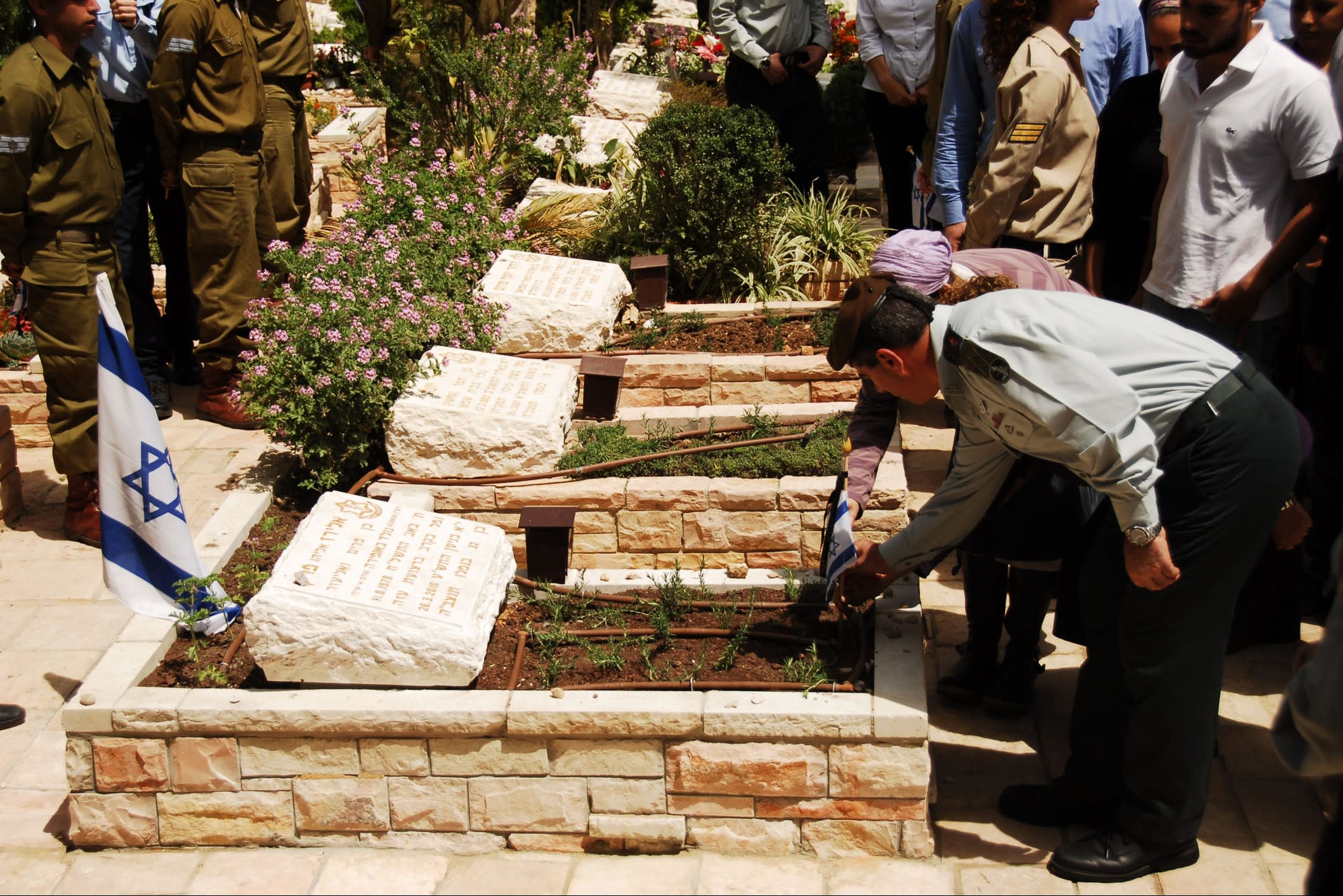
Yom Hazikaron 5778 – On the Periphery


Image result for yom hazikaron

*A student of Yeshivas Kol Torah wanting to visit the graves of righteous sages in the Galil. He posed a question of whether or not one would be allowed to interrupt their Torah studies to do so to the Rosh Yeshiva, Rav Shlomo Zalman Auerbach. Rav Shlomo Zalman replied to his pupil that one need not venture north to find graves of tzaddikim to pray at. Rather, there were plenty of “tzaddikim” who were buried on Har Herzl, Israeli’s military cemetery.

*A recent feature article in Ami magazine profiles Rabbis Avigdor and Chizkiyahu Nebenzahl, the immediate past and current chief rabbis of the Old City, respectively. Rav Avigdor serves as the rabbinic head of ZAKA, Israel’s primary rescue and recovery organization. They are volunteers who are on the scene immediately after natural disasters and terror attacks, cleaning up the havoc wrought. Rav Avigdor’s grandson, Avraham Nebenzahl, notes that he used to see his grandfather stand near the #1 bus stop outside the Kotel plaza donned in his bloodstained ZAKA uniform, tears streaming from his eyes, as he returned home from cleaning up the scene of a terror attack.

*Rabbi Yosef Zvi Rimon once related that a soldier at war once asked him if he could daven in his tank due to the less than pleasant smell inside. When Rav Rimon shared this question with an American rabbi, his North American counterpart didn’t understand the question. “One can’t pray in a scenario like that, so they’re exempt entirely!”, protested the American rabbi. Yet, Rav Rimon notes, never once has a soldier ever asked if he doesn’t have to daven. It’s simply never come up.”

On Yom Hazikron, I think about these vignettes, among others, that put me in the right frame of mind to approach this day. There are plenty of other anecdotes that will do the trick. These two capture the essence of what we’re commemorating. Rav Shlomo Zalman’s story hits me because of its poignancy. Rav Nebenzahl’s story speaks to me because I can picture this very scene playing out in my mind. Rav Rimon’s account speaks volumes of the caliber of many of the soldiers of the IDF.

The memorial is two-fold: on one hand, we remember the soldiers who valiantly fell fighting for their country, while we also reminisce about those individuals who have been victims of terror. I find myself on the periphery, making small connections to some victims. I feel uneasy making myself believe that I am much closer to these kedoshim than I actually am. I recognized one of the students killed in the Mercaz HaRav attack from living in the Old City at the same time. I’ve traversed many different places where people, both soldiers and civilians, have tragically been murdered in cold blood. Nevertheless, many of us who share this lack of first-hand connective tissue are somber today, thousands of miles away from the state of Israel.

To those with a strong connection to the land, it makes no difference how close one is to the victims. They are our sons, our daughters, our sisters, our brothers. When the Torah recounts how great the tenth and final plague was leading up to Paro releasing the Jewish people from his grip, the text states that the cry was so powerful because there was no Egyptian house that remained untouched. Each family experienced a casualty. In Israel, even if the kedoshim were not part of one’s own immediate family, the relationship is still there. A friend, a neighbor. The aggressors care not who you are or where you come from. Politicians are not spared (ask Benyamin Netanyahu). Rabbinic leaders aren’t either (ask the family of Rav Elyashiv who lost a daughter in 1948 to Jordanian shelling or Rabbi Yehuda and Rabbanit Chana Henkin who lost their beloved son and daughter-in-law not long ago).

When I think to myself that I’m on the periphery and feel foolish (almost) for getting worked up about the thousands of holy individuals who have died in the name of Israel, I am quickly pulled back to reality. The Gemara (Shevuos 39a) teaches us that the Jewish people are responsible for one another. Rashi comments that when Bnai Yisrael camped at Har Sinai in anticipation of receiving the Torah, they did so “k’ish echad b’lev echad.” The nation was so staunchly united in their mission that is were as if one person with one heart were making the decision, rather than the hundreds of thousands of people who were assembled at the foot of the mountain.

Someone once told me that they didn’t necessarily understand why we recognize Yom Hazikaron. Look up the names Nachshon Wachsman, Michael Levin, or Ezra Schwartz and tell me that you feel no sense of grief or loss. Put yourself in the shoes of the families of Hadar Goldin and Oron Shaul, who, after almost 4 years, still do not have their sons’ bodies to bury, and tell me you feel nothing. Millions of Israelis would love nothing more to treat the day before Yom Ha’Atzmaut as insignificantly as Americans treat July 3rd. Sadly, they do not have that luxury. We do not have that luxury.


Yom HaShoah 5778 – Questions

Preview Image

c4f1750c8c963cef7e1ac615dbeac9 (1).jpg

Preview Image

The Jews are a people full of questions. We are asked a question, and we will sometimes respond with another. There are times when we encourage questions en masse. As we recently celebrated the holiday of Passover, this tidbit is no doubt fresh in our minds. Pesach is a time when we not only desire questions, particularly from the children, but we organize the night in such a roundabout way that, naturally, questions are evoked. Conversely, there are often times when we are taught not to question. These are generally more painful commands. When a tragedy occurs, when someone is taken too early from this world, we are sometimes given the missive of “we do not question the Almighty” as we remain in the aftermath to pick up the pieces and move on.

This idea of asking questions has spawned a fascinating avenue in the form of sheilos u’tshuvos, Jewish responsa literature. Literally how the rabbis respond to our queries over Halachic matters. Rabbis today know that a major part of their time in the rabbinate is spent fielding shailos. In turn, they may themselves need to reach out to their own rebbeim and mentors, or outside rabbinic experts in order to know what to respond. There are volumes and volumes of rabbinic literature dedicated to answering our questions, and new volumes continue to be put out annually.

Sheilos u’tshuvos sefarim are something that I find to be riveting, although I do not often plumb the depths of many of them. In addition to the line of thinking used in giving the proper response, I’m curious to know about the mindset of the petitioner. What are they thinking? What’s going on behind the scenes that serves as the impetus for this shaila? There is one particular work that strikes me whenever I come across it are the responsa penned by Rabbi Ephraim Oshry, a tremendous Torah mind who lived in Lithuania when the war broke out. He eventually survived the horrors of the Shoah and wrote up the shailos that he received during this time. A one volume English work was published and the responsa, preceded by the stories behind each of them, are hard to imagine.

A hoarse Kohen wanting to know if he could still “duchen” with the other Kohanim.

Using garments of martyred Jews.

A Sukkah built with boards stolen from Germans.

Yet, the shaila that hit me like a ton of bricks is a more well known one. It was asked to Rabbi Zvi Hirsch Meisels, the Rav of Veitzen (Hungary), who also managed to survive the war and compile a collection of the petitions asked of him during the years of terror. In the introduction to his sefer, Mekadshei Hashem, he writes that on Rosh Hashannah 1944, there was a tremendous “selection” of 1600 boys. Those between the ages of 14-18 of a certain height would be spared and forced to endure hard labor. The others would be met with death. It somehow had become apparent to concerned parents of these boys that the Kapos (yemach shemam) would be willing to accept bribes from what the Jews were able to smuggle on their person in order to extract their child from the group. However, it also became clear to them from the Kapos that there would immediately be another boy taken in his stead to be slaughtered. A father with little money or possessions was able to scrape together enough to fulfill the ransom for his only son. He asked of Rav Meisels: would it be permissible for him to pay off the wicked Kapos in order to save his son knowing that another boy would meet his demise due to this action? Rav Meisels was trembling. He demurred, and said to this holy Jew that he was not equipped to answer at that moment and that in the times of the Temple, the entire Sanhedrin would need to be convened for such capital cases. He continued that it would be hard for him to answer such a question in Auschwitz as he did not have any of the relevant sefarim to guide him. While Rav Meisels hemmed and hawed in his mind about the various issues pertaining to this request, he nevertheless implored the father of this son to not ask this question. The father was not placated and did not accept this answer. Whatever answer was offered to this shaila, the father would obey. Rabbi Meisels again tried to deter the father, telling him that he cannot possibly render a Halachic conclusion without first consulting any sources. The father responded: “Rabbi Meisels, if this means that you can find no heter for me to redeem my son, so be it.” The Rav protested. “My beloved brother, I did not say that you could not ransom your child, and I cannot rule yes or no. Please do what you wish, as if you never asked me.”What cuts me to the core is that Rabbi Meisels points out in his sefer that the petitioner noted that this query was one of Halacha l’maaseh (see above), a practical question. Halacha l’maaseh?  We today typically associate Halacha l’maaseh with something significantly more trivial. It used to be “is this chicken Kosher?,” or “my meat spoon was accidentally used to stir my chocolate milk.” These are what we think of as practical questions of Jewish law pertinent for our everyday lives or our lives at that very moment. Would it be permissible for him to pay off the wicked Kapos in order to save his son knowing that another boy would meet his demise due to this action? 100 out of 100 rabbis would never rattle this case off as a Halacha l’maaseh case when pressed for one. The fact that the text above denotes those words, enlarged, makes my stomach churn and my head spin. The churning and spinning continue when I ponder about what will be in the next few years. In a time where we have more access to information and the ability to educate ourselves more than ever before, the memories are still fading. This year, Poland outlawed shirking any blame to their country for crimes committed during the Holocaust. To say that there was no involvement on their part is to say that you did not breathe yesterday. This above account described by the Veitzener Rav is only one of thousands. These atrocities did not happen hundreds of years ago with no one left in the wake to remember the exact details of what transpired. The holy survivors still are among us! On this Yom HaShoah, even more than we owe it to ourselves to pass along their stories, we owe it to them. Over the course of now until the next Yom HaShoah, we will no doubt lose more of these unbelievably heroic individuals. Where will that leave us? What will we do? The next generation will have questions, and we are no doubt tasked to answer them.

Pidyon HaBen Remarks from Estee & Willie Balk

PH.jpg

Estee’s speech appears first. Willie’s appears second. Mazel tov!

Thank you all for coming to share in our simcha. We feel blessed to be able to have so many people in our corner to experience this high point in our lives together. It’s unbelievable how our lives have changed in one moment, and we’ve been on a high ever since.

We specifically would like to thank our parents being there for us in so many ways in reaching this moment.

When deciding what to name our son, we knew that we wanted to name him with some combination of the names Yaakov and Yehoshua after Willie’s beloved great-grandfathers. These names were meaningful to me because of who these characters represent in Tanach.

Yaakov Avinu stands for Emes, truth. He lived a life of hardship after hardship. Running away from home, tricked into marrying Leah and being led to believe for years that his most beloved son was dead. His relationship with Esav was tumultuous before they even left the womb, a relationship that thankfully, my twin brother and I do not have. What makes Yaakov so great? That he struggled? Yaakov’s greatness is reflected in how he lived with all the struggle, all the pain and uncertainty in how his life would evolve. Yaakov Avinu’s entire being still represents Emes, truth. With all his trials and tribulations, he was able to stay connected and epitomize what it means to be an Eved Hashem.

Yehoshua is among a few people in Tanach that had a name change. Moshe Rabeinu changed it from Hosheia to Yehoshua by adding a Yud at the beginning. What is significant about the letter Yud? The gemara shares that the first two letters in Yehoshua’s name now starts with the name of Hashem. Moshe wanted to give Yehoshua extra protection in order to stand up to the 10 Meraglim that were going to speak badly of Eretz Yisroel. We see Yehoshua develop into the leader that Moshe knew he could be. Yehoshua and Calev were able to remain true to themselves as they tried their hardest to save their colleagues from giving a false report. He was not afraid to stand up for the right thing, even when the right thing is not the popular thing to do. Additionally the Da’at Zekeinim adds that the Yud represents 10 shares of land that Yehoshua would inherit. Moshe indicates that Yehoshua would inherit the 10 shares that would have been the shares of the other ten spies, had they not slandered the land of Israel.

Menashe, Yaakov’s grandson, grew up far away from his grandfather’s home. Yet, even in Galus Mitzrayim, he was still on such a high level that he was considered like one of Yaakov’s sons. He even earns a shevet in his name. One famous story about Menashe is when he received the bracha from Yaakov who was on his deathbed. He puts his left hand on Menashe’s head and right hand on Efraim’s head, which confused Yosef. As Yosef’s bechor, Menashe deserved to have the right hand on his head while receiving a bracha from his grandfather. Nevertheless, Menashe doesn’t say a word. It is Yosef that is astounded by his father’s choice in switching his hands and putting the right hand on Yosef’s younger son Efraim. Commentaries explain that Yaakov did this because he saw that Efraim’s descendants would grow to become greater than Menashe’s and therefore Efraim earned, so to speak, to have Yaakov’s right hand. Menashe’s silence on this matter speaks volumes. Menashe doesn’t argue, doesn’t speak up respectfully, he doesn’t feel the need to change his grandfather’s mind because he gets it. Menashe understands that Efraim will become greater than him and he’s ok with that. Menashe knows who he is and just because his younger brother will be great does not mean he won’t be as well. In fact, this is the first time that we see in Tanach, that brothers can get along.

When Willie and I were considering different names to reflect our journey, we liked a few options but nothing stood out. Then the name Menashe came up and we both loved the name for various reasons. Willie already mentioned at the bris “ki nashani elokim es kol amali” How Yosef thanks Hashem for helping him forget the struggle he endured in his father’s house and blesses him with a son. Additionally, the letters of the name Menashe can be rearranged and spell Meshaneh, change. This journey truly changed us and it is our bracha that Yaakov Yehoshua Menashe should continue to change our lives for the better.

Words cannot express our gratitude to Hashem. The Pasuk in Shir Hama’alos says  “Ha’zorim b’dima, be’rina yikzoru” “Those who plant with tears, will later reap with joy”. While tears are flowing, it’s almost impossible to imagine or even picture the simcha that will hopefully, eventually come to fruition. We’re are so happy to be here today reaping with joy as we get ready to redeem our son tonight.

I’d like to end with one last message. Years ago when I was learning in seminary we had a weekly class with Rebbetzin Tziporah Heller and it must have been before Pesach when we had a discussion about galus mitzrayim. I remember asking her a question I had for a while. I noticed that Galus and Geulah have the same root word, Gal and I couldn’t figure out why. How could such opposites be linked together? Rebbetzin Heller shared a very powerful message. Gal in hebrew is a wave. She said that in Galus we feel waves and waves of suffering. Just when we think we’ve hit rock bottom so to speak, it gets worse. And it will be the same when the Geula comes. We will Be’ezrat Hashem experience waves and waves of goodness and just when we think life can’t get any better, Hashem will bestow even more bracha upon us. I’ve shared this idea many times since hearing this years ago however over the last month we’ve experiences more waves of goodness than we could have imagined.  

Willie, over the last couple years we’ve always said “If we could get through this, then we can get through anything”. There are no words that can thank you enough for always being there. I may have been the one to physically go to all appointments and take medication, but it was only doable because you’re there. This last month has been truly amazing, even with the lack of sleep. I can’t wait to experience more and more moments like these together.  Yaakov Yehoshua Menashe doesn’t know yet how lucky he is to have you as a role model in all areas of life, a sports fan, and of course as a father.


It’s bashert that we’re here tonight to celebrate the pidyon haben of our bechor. One week from right now, we’ll be gathering in our homes for bedikas chametz in preparation for Pesach. My Rebbe Rav Elchanan Ehrman reminded me that the Exodus from Egypt is mentioned in bentching where it says “ufdisanu mibeis avadim,” that Hashem redeemed us from the house of slavery. The word, ufidisanu comes from the word Podeh, to redeem, which is exactly what we’re doing here tonight.

When Hashem took the Jewish people out of Egypt and subsequently takes them as His nation, the pasuk in Devarim states vayotzi eschem mikur habarzel, I took you out of the iron crucible for Me as a nation. The Midrash says that when klal Yisrael were in Mitzraim, they were connected like iron to the Egyptian people and their way of life. What does that mean? In order to make iron, you take a bunch of different substances and melt them together at very high heat. The naked eye cannot determine the different components when glancing at it, and that’s how Bnai Yisrael were in Egypt. Other than the fact that the Jewish people were slaves, there was not much differentiation between them and a random Mitzri. There was no milah, they were ovdei avodah zarah, nothing uniquely connecting them to the Creator other than the fact that they were themselves Jewish. Nevertheless, Hashem chose them as His nation, and He redeemed them. If we were called in for an interview with the Almighty and He told us that we were the Am HaNivchar based upon our experience in Egypt, we would be so perplexed. Don’t you see us? Don’t You see how we’re living, what we’re doing? What we’re not doing? We have nothing, and You know that more than we do! THIS is what you want? Absolutely. He chose us, and we remain His people.

I heard a shiur from Rav Avraham Tzvi Kluger on this topic this past week, and it immediately reminded me of the mitzvah that we’re about to perform. Baruch Hashem, Estee and I were blessed with a son. Those of you in the room who have yet to be blessed with children may not be privy to just how much a parent gives to their child. You will no longer sleep through the night because you will need to feed, clothe, or bathe your child. Even during the day, time when you would be awake anyway, the child still requires tremendous care. Not to mention how expensive it can be to raise a child. The doctor visits, daycare, later tuition. Your newborn will deplete you of your time, sleep, money, your kochos, just about every resource you can imagine. For Estee and I and many, many other couples, as you know, the road is even longer. The pain of tzar gidel banim pales in comparison to the tzar of wanting to gidel banim. Now I ask you, THIS is what you want?! The answer, is a resounding yes.

Just 49 days after Bnei Yisrael were redeemed from Egypt, despite their level of tum’ah, as we know, they merited ascend to such spiritual heights that received the Torah, to stand at the foot of Har Sinai and witness the most awesome of sights. We know that right now, our little Yaakov is small and requires much more meticulous care like any other small child, but we as we say at the Bris Milah, zeh hakatan vegadol yihiyeh, that this diminuitive child will one day grow and flourish into a wonderful source of yiddishe nachas for his family and his community. Yaakov, we love you so much, and we are so grateful to Hashem that you’ve entered our lives.

Yaakov Yehoshua Menashe Balk

balk-3796-L.jpg

Hodu L’Hashem Ki Tov, Ki L’Olam Chasdo.

Thank you all for coming to celebrate the bris of our bechor, Yaakov Yehoshua Menashe Balk. You really find out who your friends are when you make a bris on a fast day morning, so it’s a pleasure to share our simcha with you all. Before delving into the meaning behind our son’s name, there are so many words of thanks that need to be offered. First and foremost, to Hashem for setting everything in motion and supporting us at every juncture. We must express our thanks to our doctor Rabbi Dr. Eli Rybak, who, in addition to being a talmid chacham, is a tremendously gifted clinician. He, Briana and our other nurses, and the entire staff of RMA of NJ, through the work they do guided by the Almighty, are the reason that we are standing here celebrating today. Similarly, there are not enough words to express our thanks to our parents who have guided us to reach this point as well. We are so lucky to have you as role models, and hope to be blessed with your guidance for many happy, healthy years to come.

Our son’s first name is Yaakov, and is in memory of my great-grandfather, Jack (Yaakov) Balk. He emigrated to the United States, but as traditional channels had been all but blocked, he entered the country via San Francisco. He settled in St. Louis, the home of many Balk relatives, and worked as a butcher. Eventually, he rose among the ranks to become the manager of a large grocery store in downtown St. Louis. He was known to be very thorough in his work, only willing to stock the shelves with the finest quality meat. It earned him the moniker “Send ’em back, Jack”, a nickname that he used in commercials for the establishment. I was not privy to know about these commercials until after he passed, but fortunately for me, I got to know my Grandpa Jack. There’s a picture that hung on my bar mitzvah collage in the hallway of my (now old) house of Grandpa Jack holding me as a newborn, with a smile on his face as wide as the Mississippi River. I recall the trips we’d take to his apartment on our vacations in St. Louis. On one such journey, my mother had the foresight to bring along my siddur and mini-tallis from my first grade classroom. I stood in Grandpa Jack’s living room and proceeded through my entire davening regimen, which as a 7 year old was not as extensive at our tefillah this morning. Nevertheless, the smile on his face that day was identical to the one from the picture taken years before.

Our son’s second name, Yehoshua, is in memory of my mother’s two grandfathers, Samuel Radman and Samuel Hornstein, who were both Yehoshua. I was not privileged to meet either of them, and do not know much about them. I can tell you that Samuel Radman and his family traveled on foot, across much of Russia before they were able to flee Europe and arrive on American shores. He was a simple man who had an enormous love for his family. He owned a grocery store and an ice cream parlor, and could often be seen sporting a coat and hat, even throughout the sweltering humidity that is a St. Louis summer.

In terms of the other Yehoshua, my great-grandfather Samuel Hornstein, he moved to the United States from Egypt and was married to Grandma Dena, my mother’s grandmother. My sister is named after Gram, who lived with them, and shaped the lives of my mother and aunt. He had rich olive skin, which could be seen clear as day in the picture of him that was kept on the hi-fi in the foyer of our Lyman Blvd. home.

Grandpa Jack and Grandpa Sam Radman share a yahrtzeit, the 7th of Adar, only a day after the birth of our son. Grandpa Sam Hornstein’s yahrtzeit falls just a few days after the date of what will be, with God’s help, the Pidyon HaBen for his newest great-great-grandson.

His final name, Menashe, is one that has no particular familial leanings, but one that evokes an immense sense of meaning for us. In the Torah, when Yosef and his wife Osnat give birth to their first child, they name him Menashe, and the pasuk continues “ki nashani Elokim es kol amali, that God caused me to forget all the toil I endured.” Here Yosef is referring to the less that stellar childhood at the hands of his brothers, later being sold into slavery, and being completely disenfranchised and broken as he was thrown in jail. While these experiences were numbing, Yosef is ultimately remembered as Yosef HaTzaddik, a righteous hero, who saved Egypt from the brink of disaster. Yet, the pasuk writes that “God caused me to forget.” How is that fathomable? How is it possible that Yosef could forget all of these things, the entire makeup of his formative years of his life? These were not mere random occurrences that happened once or twice. Are we to believe that every trial and tribulation of Yosef’s existence all at once slipped his mind?

I think the answer lies in the fact that while these events that peppered his upbringing and time in Egypt were unbelievably daunting, he was not defined by them. Yosef could have surveryed his lot and decided that he was a lost cause, doomed for all eternity. Even when something fortuitous happened, it was often bookended by a more nefarious affair. Yet, with the help of Hakadosh Baruch Hu, his tides turned drastically and his story is remembered differently for all time.

While not on such an extreme level, this single pasuk speaks volumes to me and Estee. The path to having a child was not an easy one for us. It was roundabout, and we were met with twists, turns, forks in the road, and dead ends. Yet, despite the challenges and hurdles we faced, we are here today with our son. Does this momentous event negate the oceans of tears shed? The sometimes multi-weekly 5:30 AM doctor visits? The injections? Absolutely not. Those things don’t just go away. Sadly for us, it also doesn’t erase the fact that my mother, the person who probably wanted this child more than anyone, will never physically be here to play with him or watch him grow.  But living in this moment, the feeling of shehechiyanu v’kimanu v’higiyanu lazman hazeh, makes those events pale in comparison to the euphoria we feel today, and that we’ve felt since 6:19 PM on February 20th of this year. We are again so thankful to our doctors, but also to Bonei Olam which helps couples financially deal with the fertility treatments, and Yesh Tikvah and ATIME, for giving us the chizuk we needed to not remain inert. We hope that the individuals we’ve encountered from these unbelievable organizations are zoche to the same palpable simcha that we feel at this very moment bimheira beyameinu.

I wanted to close with a note about my wife, Estee. Every single husband who gives a bris speech talks about how incredible their wife was during the pregnancy and labor, and how they love them. I don’t want to give the wrong impression, as this is no doubt true for my wife as well. However, those words do not do justice to how incredible Estee is. She is literally the reason that our son is here today, and not just because she carried him inside of her. Since we began the journey of trying to have children, it was Estee who became a sponge and soaked up every single piece of information about the medicine she was taking and the course of treatment we were up to. It was Estee who would be on the phone with the insurance companies. It was she who would be calling the doctors, nurses, and pharmacies staying on top of what we were up to. There were times when her acumen saved our rounds of treatment from utter sabotage. She has been the biggest advocate for this child for over three years, before he was born. I have seen the care and concern she exudes, and I know there are no better hands for our children to be in than hers. Estee, I do not know what I did to be zoche to having you as my wife, and I do not want to think about where I would be without you.

Thank you all again for making our simcha so special. While we are not 100% sure of what we will be calling our new son, we are certain that he is perfect and he is our miracle.

Have an easy fast, a freilichen Purim.

Terumah 5778 – Taking From Ourselves

In Parshas Terumah, Bnai Yisrael are in the aftermath of receiving the Torah, hearing the litany of laws that we as a mamleches Kohanim, a sanctified nation are to uphold. Klal Yisrael responded to the charge of Hashem with a resounding Naaseh venishmah, we will do and we will listen. Now, it’s time to put our money where our mouth is, so to speak and the task at hand is the construction of the Mishkan. The parsha begins “Daber el Bnai Yisrael vayikchu Li terumah me’eis kol ish asher yidvenu libo tikchu es Terumasi/Speak to the children of Israel, and have them take for Me an offering; from every person whose heart inspires him to generosity, you shall take My offering.” Chazal point out immediately that the wording of the pasuk is interesting. Usually, when one talks about tzedakah, it would say vayitnu Li, not vayikchu li, to give charity, rather than to take charity. When one decides to give generously as described in the pasuk, it implies that the action is something that they want to do, that they would plan on doing. Taking infers that it’s something you would rather not do. You don’t give money to the government for taxes, they take it from you! The phrasing almost brings to mind one minding their own business during davening and the gabbai reaching into your pocket, taking out a $10 bill and stuffing it in the pushka. What does this wording of “vayikchu Li terumah, take for Me an offering” mean?

A more “Litvishe” answer examines the “pashut pshat,” that Hashem is telling Moshe to set up gabba’ei tzadaka, officers who would go out and directly receive the funds from the masses. That’s why the Torah states that they should take for Me an offering. A second, slightly more “chassidishe” answer is that this commandment from Hashem requires of us to take from the gashmius and the chitzoniyus, our material and external possessions and sanctify His name. Hashem is the source of all, the ultimate baal tzedaka to the world. The money that we accrue in our lifetime belongs to him and is meted out for us at the beginning of every year, a fact that’s not easy to remember. We take the mundane and make it holy. The Ramchal adds in Mesilas Yesharim that when a person sanctifies himself with the holiness of his Creator, then even his routine actions become matters of kedushah. Continues the Ramchal that one whose life is completely encompassed by the observance of mitzvos, it is as if he is walking before Hashem in Gan Eden, while still living in this world. By living a life of kedushah, the most miniscule daily tasks and seemingly ordinary items can be met with a high level of sanctity. A dollar bill has no holiness. But when you give that dollar to someone or something that can use it and really needs it, you are making it holy.

Mishpatim 5778: The Message of the Brick

Image result for bricksContinuing in the footsteps of the Aseres HaDibros in Parshas Yisro, Parshas Mishpatim, as the name of the Sedrah would tell you, is replete with new laws and statutes for the Jewish people to uphold. Toward the end of the Parsha, Moshe Rabbenu, Aharon, Nadav, Avihu, and the seventy elders ascended Har Sinai and caught a glimpse of the throne of God. The pasuk states: “and they perceived the God of Israel, and beneath His feet was like the forming of a sapphire brick and like the appearance of the heavens for clarity.” At first glance, the vision of a sapphire brick seems puzzling. What is so unique about a brick? Could there not be something more inspiring or meaningful that could’ve been portrayed to the leaders of the Jewish people?


Rashi explains that the reason for the Livnas HaSapir, this sapphire brick, served as a reminder of the trials of Bnai Yisrael in Egypt, reminiscent of the bricks that they had to make in their harsh labor forced upon by Paro. Some explain that this was done as a measure by God to show that He was with them throughout their struggle with the tyrannical Egyptian regime. Just as there were bricks while the Jewish people were enslaved in Egypt, so too there is a brick now, part and parcel to the Kisei HaKavod.

There’s an answer that speaks more to me, one that I heard from my teacher Dr. David Pelcovitz in a semicha class of ours. While it’s important to look to the future with our hopes and dreams, the Jewish people are a nation that constantly is looking back. The the lesson of Livnas HaSapir is not only that God remembers the bricks from Mitzrayim, but as Rav Yerucham Levovitz explains, that we must remember the bricks as well. Even in times of happiness, we remember the past. The experience of being enslaved in Egypt, even though Bnai Yisrael was no longer there, needed to stay with them to serve as a constant reminder, not necessarily of the horrible yoke of slavery, but to serve as their guidebook as to how to treat other people.

If one were to examine the laws that are written about the Hebrew slave from our parsha, you would see that they are treated fairly differently that one might expect. The experience of an even Ivri in their master’s home differs significantly to the experience of the Jewish people in Egypt or the slavery that existed in the United States before being outlawed. There are no whips, shackles, or harsh labor. Furthermore, there are many times in this Parsha and other places in the Torah that inform us that we must treat the stranger among us with respect, because we were once strangers in Egypt. We know how it feels to be uncomfortable. To not fit in. To be persecuted. We’ve experienced the pain first hand. The affliction levied by the Egyptian taskmasters gripped Bnai Yisrael with such terror. How on earth could we subject any other individuals to that sort of dastardly behavior? Therefore, we aren’t just supposed to be better: the Ribono Shel Olam set into motion a course of action whereby we MUST be better. God is setting the standard for us. We cannot act that way because the shoe has been on the other foot, so to speak. The pain is not long lost on us.

Yisro 5778 – Tangible

Image result for har sinai

Parshas Yisro portrays the aftermath of Bnai Yisrael’s exodus from Egypt. For the most people, the crescendo of this Torah portion is the reading of the Ten Commandments, arguably the most well-known passages in the entire Five Books of Moses. As the Jewish people camped at Har Sinai, they were told all of these things with great fanfare.

The Aseres HaDibros begin “Anochi Hashem Elokecha asher hotzeisicha m’eretz Mitzrayim” that I am your God who took you out of Egypt. Rabbeinu Bechaye brings to light an interesting question regarding the preamble to the Ten Commandments. Why does God list Himself as “the One who brought you out of Egypt?” Isn’t He selling short His greatness and might? Why not refer to Himself as the Creator of the entire universe? Isn’t that the much more amazing achievement? Rabbeinu Bechaye points out, without using these exact words, that this is a clear case of “eino domeh shmia l’re’iya,” that merely hearing about an event that transpired does not compare to actually seeing it. The Jewish people were on the heels of witnessing unparalleled miracles. Not only were they witnesses to greatness, they lived it. It benefited them explicitly! It would have been enough for them to have merely been able to escape the hard labor forced upon them by the tyrannical regime of Paro. However, to be taken out of the clutches of their generations-long aggressors in the manner in which the ten plagues and splitting of the sea occurred was unimaginable. Over the top doesn’t even begin to cut it. Rashi explains that God is saying here that for this reason alone, the entire story of Yetzias Mitzrayim, is enough grounds for you, Bnai Yisrael to be subservient to Me. Hearkening back to the creation of the world, says Rabbeinu Bechaye, will not convey the same message being referred to as the One who brought about such tremendous miracles, that you saw and gained immensely from.

This concept of “eino domeh shmia l’re’iya” is a famous one in our heritage, and the world we live in today almost demands it. How can we make our Mesorah, the beautiful story of the Jewish people, applicable and enticing to the next generations? The children of today are at a greater danger than any generation before The apathy that permeates Jewish society is growing. What do we do? How can we make Judaism relevant to children and adults alike?

Rabbi Moshe Shapiro was fond of mentioning the first Mishnah in Pirkei Avos in relation to this monumental task. The Mishnah begins “Moshe kibel Torah M’Sinai” that Moses received the Torah from Sinai. We know that Moshe received the Torah from the Almighty at Har Sinai, but the words of the Mishnah simply mention “Sinai.” Rav Shapiro explains that when we too transmit our “Torah,” it has to be a Sinaitic experience. Immediately following the Aseres HaDibros, the Torah mentions that there was fire and lightning, and the excitement among the Jewish people was palpable. That fire and excitement needs to be there for us as well.

The single greatest thing that I ever did in a classroom was try and implement a sense of tangibility to our heritage. There’s an NCSY educational activity that I was part of on a Shabbaton led by a wonderful friend and colleague of mine, and I used it in my classes. Each student in the room was given strips of paper with one sentence and a number on them. There were over 100 pieces of paper. After talking about how long ago they thought the Torah was given (with wonderful answers) we began to trace ourselves back from the very classroom we were in to Moses at Sinai. Each strip had a different person mentioned, and the teacher from whom they learned the Mesorah. Slowly but surely, we made it back to Har Sinai, and my students were wowed. When something is real, and it’s able to conjure up a sense of meaning, it’s significantly more powerful.

This is exactly why God tells the Jewish people at the beginning of the Ten Commandments that He is the God who took them out of Egypt, because they themselves were there. Nobody had to jog their memory about events they may or may not have known anything about: they were sitting front row to unbelievable nissim v’niflaos.

Tu B’Shvat 5778 – Roots

Image result for date palm tree

On Tu B’Shvat, the Rosh Hashannah for the trees, we colloquially recognize the vegetation around us. Many have the custom to recite Perek Shira, a generations old text whose author remains unknown, delineates 84 different creatures or things from which we can learn tremendous lessons about ethics, wisdom, and advice on seeing the hand of God. These items in Perek Shira range in category from things in nature (sun, stars, moon, different types of clouds, dew, and others) to animals and insects, to plant life.

One of the items listed in Perek Shira is the tamar, the date palm. The tamar is one of the shivat haminim, the seven unique species of Israel, typically listed as “devash.” Devash today usually refers to honey, yet among the shivat haminim, it refers to date honey, as regular honey does not come from the ground. 

It’s written in Tehillim and we recite in our tefillot “Tzaddik Katamar Yifrach” that the righteous will flourish like a date palm. What does that mean? What is so unique about this type of tree? It’s not the tallest nor is it the one which produces the most fruit. My teacher, Dr. David Pelcovitz tells a story of a friend of his hiking in the desert on the West Coast of the United States. On this hike, he encountered a date palm tree rancher (yes, they do exist!). The hiker, realizing that a date palm rancher was not someone that he usually came in contact with, asked him tell me something about the plants that he so diligently cared for. After demurring a few times, the rancher responded that the only way to create dates that are commercially able to be sold is if the date palm trees are next to each other, enabling their roots become entangled together.

As the hiker walked away from the rancher with this seemingly trivial tidbit in mind, it occurred to him that the message here is poignant. If one were to simply desire to grow dates without the intent to sell them, they could position their trees as they wished, without a care for how they were positioned. However, if one sought to have dates that were able to be sold and consumed, they would need to be grown in the fashion the rancher stated, with a strong network of roots interconnected with the roots from other date palms. In order to grow and flourish properly, like the dates, our roots must be strong and connected. We must commit ourselves to being rooted in Yiddishkeit, maintaining the bond between ourselves and the Almighty. When we connect to the roots of our past, we can successfully help plant the roots for the generations to come.

Beshalach 5778 – Belief in God, Belief in Ourselves

Parshas Beshalach chronicles Exodus of the Jewish people from slavery in Egypt following the ten plagues that ravaged the country. The verse states that as they were leaving Egypt, having seen the strong hand of the Almighty, Bnai Yisrael feared God, believed in Him and believed in His servant Moses as well. They believed in Hashem who brought about the miracles, and they believed in Moshe as the Divine emissary who was there to guide them.

Rabbi Tzadok HaKohen of Lublin writes that “Vayaaminu BaHashem UvMoshe Avdo” means more than that. He notes in Tzidkas HaTzaddik (154) that just as Bnai Yisrael believed in Hashem and Moshe, we are to believe in ourselves as well. Hashem, he writes, has an “esek” with us, “business” so to speak. It is He who puts us on earth for a specific reason with unique goals for us in mind. This notion ties in with the first thing that a Jew is to do upon waking up. We recite Modeh Ani, thanking Hashem for restoring our souls to us each day. This prayer concludes with our reciting “Rabah Emunasecha, great is Your faith.” Great is Hashem’s faith in each of us that He brings us back every day with a renewed soul to tackle our day and our responsibilities, which can be enjoyable at times, while debilitating at others moments. These are reminders are constant affirmations: Modeh Ani and Az Yashir are daily parts of our prayer liturgy! May we be inspired through Hashem’s confidence in us to have the strength to face any challenges we encounter.

Tzaddk.PNG

Tzidkas HaTzaddik 154

Bo 5778 – 4 Days

sheep_animal_meadow_grass_farmland-62969.jpg

In Parshas Bo, situated between the final plagues levied upon the people of Egypt, the Jewish people are given specific mitzvos to follow. The first is to set a calendar for themselves, and sanctify their time. Rabbi Soloveitchik, among others, note that this was of paramount importance for the Jewish nation on the brink of leaving Egypt as a free people. For the previous generations they were slaves whose time belonged not to them, but to their masters, and at the precipice of Yetzias Mitzrayim, Bnai Yisrael needed to be able to sanctify their time once it became theirs once again. Immediately after this mitzvah, the Jews are given another: to take a sheep for each of their households on the tenth day of this month (the first of month on their nascent calendar). This young, unblemished animal was to be used as the Korban Pesach, and the protocol for what is supposed to take place is delineated in these verses.

We know that the Korban Pesach is to be eaten on the 14th of that month, a full four days after Bnai Yisrael were commanded to bring it into their midst. This seems a bit puzzling. What else were the Jewish people doing at this time that they needed this vast amount of time to check their sheep? This is a task that could’ve taken an hour or two, maybe a whole day if one were to really search thoroughly, yet Bnai Yisrael are given much more time than that.

It’s understandable that the Jewish people would need to exert great care in this mitzvah. They were a broken people, racked with years of harsh labor. They knew no other way of life. They had been surrounded by idol worshipping Egyptians, as well as members of their own communities. This was their first real foray into mitzvah observance. I believe their lengthy amount of time to ready themselves and scrutinize the animal they’ve been told to keep safe is to guide the Jewish people into an ultimate existence of strong Mitzvah observance. This idea is evident as Paro tries to outsmart the burgeoning Jewish population in Egypt. He commands the Jews to perform backbreaking work, befarech in Hebrew. The Midrash plays on that word and writes that Paro dealt with them b’peh rach, by speaking softly to them to be eased into this work. The transformation that they were about to undergo at the hands of God would bring about a new way of life for them, and in order for it to be success, they had a significant amount of time to do their first task.

I heard a second perspective on this event from a friend of mine who is a tremendous marbitz Torah and anav, that he explained from Rabbi Dovid Goldwasser. This entire episode showcases to us chashivus hamitzvos, the importance of the mitzvos we are doing. The Jewish people are given four days to make sure that no part of their sheep is impure. It’s holy work that needs to be done with great, meticulous care. This message is one that we should strive to implement in our daily lives. Nowadays, we have no Korban Pesach to bring on the night of the Seder, but we have a plethora of mitzvos that have been commanded to us by the Almighty. We cannot robotically seek to fulfill them as if we’re working on crossing off items on our to-do list. We are set to do the mitzvos anyway: why not do them correctly?

Bnai Yisrael ultimately saw a momentous yeshuah as they were redeemed from slavery in Egypt by God. May we be privy to a similar salvation, bimheira beyameinu.