Belated Father’s Day 2016-5776

Rabbi Soloveitchik used to deliver a monumental lecture on the occasion of his father’s yahrtzeit, an event that was widely attended and has even been written up into a book. Rabbi Binyamin Tabory, in The Weekly Mitzvah, records an interesting note from The Rav about honoring one’s parents, the mitzvah focused on for Parshat Yitro. He mentions that what one does for their father, they must also do for their mother. The Rav explains that ideally, he should be giving two of his famed yahrtzeit drashot, one for his father and one for his mother. He explained that the only reason he did not deliver two of these speeches was because he didn’t have the strength to prepare and deliver two such lectures.

I wrote an entire message for Mother’s Day, so it would only be fair to share the same sentiments regarding Father’s Day, but I didn’t do it. Sorry. So now, I would like to publicly thank and recognize those individuals in my life. Better late than never, right?

That starts with recognizing those who are no longer with us.

First, my Grandfather Willie Radman, who I am named for, is someone that I never met but remember hearing from my mother how similar we are and how proud he’d be of me.

My great-grandfather Harry Chanen, who I am also named for, is someone who passed away a while before my birth, yet he and my great-aunt Audrey had the foresight to record his life story. I’ve read his autobiography cover to cover, and am enthralled each time, wanting so much to have had the opportunity to have met him.

My great-grandfather Jack Balk was someone who I was lucky enough to meet and remember, even though he passed away when I was still young. The moment that is emblazoned in my mind forever is when I brought along my little tallit and siddur from school to St. Louis and showed him how I davened. I don’t recall what he said afterward, but the smile on his face meant the world to 6 year-old me, and I still look back on that memory fondly.

I don’t know how I lucked out in finding my wife, Estee, but I am doubly blessed by her amazing family. I am zocheh to have a father-in-law who treats me like a prince, a person who shares my love of a good potato kugel. He creates opportunities for learning in his shul in Teaneck that enhance the religious fiber of the kehillah. He’s done so much for me in the time that Estee and I have been married, and for that, I am truly grateful.

Saba is the head of the Balk family. One need not delve that deeply into the fabric of Jewish life in St. Louis without encountering the name Ed Balk. What makes me proud to be his grandson, more than the beautiful family he’s raised and the successful business he’s a part of is his connection to synagogue life. Anyone can be the synagogue president (which he was), but his greater accomplishment, to me at least, is being a seasoned, exceptional baal korei. That takes more time and dedication than attending meetings and sitting on committees. That is a true legacy. May he and my Savta have many more healthy years together.

Finally, I thank my father for literally being the biggest driving force in my life. He is the smartest person I’ve ever been around. True, I’ve met individuals who are more book smart, as well as those who are more street smart. Yet, I have not come in contact with anyone who so flawlessly has a command of the two like my father. He’s a bigshot, but unlike any of the others you’ll ever meet. He does not care for the spotlight, shuns any and all awards. I cannot begin to tell you about the ways that he and the Mt. Sinai Healthcare Foundation have improved life for Jews, senior citizens, and inner-city students, as well as the health policy initiatives that he works toward in Cleveland, Columbus, Washington DC, and beyond. The work of the foundation has garnered much recognition and a few awards, but my sister and I barely hear about it. When we do, it’s from others who marvel from the outside. I am far prouder of his accomplishments as a congregant from the bimah (reading Torah, haftorah, and davening) than I am of the amazing work he did as president of the shul, helping ensure that a new campus was funded (but we’re proud of that, too). I watched him diligently care for my mother for the 13 years that various illnesses ravaged her health. My mother used to say that she hoped that if , Heaven forbid, the shoe were on the other foot, so to speak, that she would care for my father as lovingly and dutifully as he cared for her. I saw this care firsthand after having surgery, and it was truly incredible. I could go on for days of other accomplishments and things that my dad does, both directly and indirectly, that make me proud, but I’ll spare you all. Thank you Dad, we love you so much!
School’s Out!

Screen Shot 2016-06-14 at 9.35.42 PM.png

With the school year winding down, I’ve been doing a lot of reflecting. The ups and downs, what was great and what maybe could’ve been better. This was my first foray into having my back toward the board rather than facing it. It took a lot of getting used to, some things came quickly, while others I still have yet to grasp. With this year under my belt, it’s my hope that I’ll build off the successes and strive every day to get better and better, enabling me to one day look back at a career which was spent innovating rather than remaining stagnant. There are those who have years of teaching experience, while others have years of first-year teaching experience, and I hope to one day be counted among the former.

The part of the year that stands out most to me is Pesach. In my Chumash class, we learned Sefer Shemot, detailing the causes for the ultimate enslavement of the Jewish people under Egyptian rule, and later delved into their ultimate redemption and receiving of the Torah. In my Gemara class, we plumbed the depths of Arvei Pesachim, the 10th and final chapter of Masechet Pesachim, which mentions aspects relating to the nuances of the Korban Pesach as well as the various details of the Seder. It was a time of great learning for my students and myself as well. However, the catalyst for Pesach what stands out the most is something other than the verses detailing the Exodus from Egypt or the Halachic guidance from the lines of the Talmud. It has to do with a unique take on an old Pesach project.

For about as long as the Jewish people have been out of Egypt and enrolled in Jewish day schools, it seems as if there have been no shortage of Pesach Divrei Torah booklets. Some are created early on in elementary school and never to been seen again after that year’s Sedarim, while others stand the test of time and are brought out annually with the matzah covers and the fruit slices again and again. The idea for a new take on the Dvar Torah compendium of one’s youth was pitched by Aryeh Eisenberg, my mentor and CEO of Bonim B’Yachad, an Israeli company that is revolutionizing online distance learning in Jewish day schools.

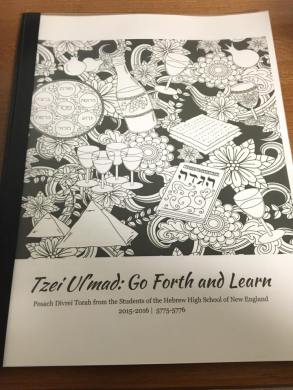
Here is how this venture took shape. In each of my classes, I assigned a Pesach Dvar Torah, something original or based on a source that related to any part of Pesach (with extra credit given to those who wished to submit more than one Dvar Torah). The plan was to get thoughtful insights from my students to cull together into our journal. I didn’t have to hope for articles or nag specific students time and again to submit something because this was not an extra project that they would have to undertake. Yet, in a way, it was sort of a gamble. Would the students hand in satisfactory work? It’s one thing to submit a bad assignment, but another if that assignment is printed for all to see! Furthermore, this was a project that we undertook that would leave very little time for error in order to have the journals ready by yuntif. Would we make it? Once the assignment was given, the submissions came rolling in. The topics encompassed Yetziat Mitzrayim, different parts of the Seder, analyses on Halacha and Minhag as they relates to the holiday, Pesach through the lens of the Gemara, and others. To say that I was impressed with my students is a severe understatement. With the aid of a team of student editors (also for extra credit), “Tzei Ul’mad: Go Forth and Learn” was born. With the support of HHNE’s head of school, Rabbi Jeremy Bruce, our booklets were printed for the three main feeder communities to enjoy over Chag.  I thank Rabbi Bruce, and especially Aryeh, along with everyone else who helped make transform a mere idea into a source of tremendous pride and “yiddishe nachas” for my students and their families. It can be accessed here

As I wrote in the introduction to this journal, I had always been puzzled by the following statement of Rabbi Chanina which is found in Masechet Taanit (7a):

הרבה למדתי מרבותי ומחבירי יותר מרבותי ומתלמידי יותר מכולן

“I have learned much from my teachers. I have learned more from my colleagues than from my teachers. But I have learned more from my students than from all of them.”

I have merited the opportunity, whether I deserved it or not, to learn from some of the preeminent Torah scholars of our time.

I am lucky enough to have colleagues who are of sterling character and vast Torah knowledge, well on their way into becoming the future torah leaders of the Klal Yisrael.

But one’s students? How could it be?

Only once I set foot into the classroom as an educator, did I realize just how accurate the words of Rabbi Chanina are. My students are smart, insightful, and eager to learn or offer their own interpretation on the topic at hand. They ask deep, penetrating questions; some I anticipate, while others seem to come from out of nowhere and stop me in my tracks.

It was a pleasure teaching them, and being able to put together this journal of their Torah ideas.


13062178_10205946896378222_4779235990138794429_n.jpg

The finished product!

Yom Yerushalayim 5776

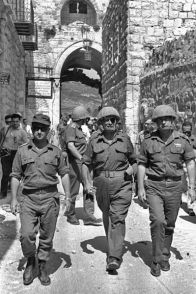
Flickr_-_Israel_Defense_Forces_-_Life_of_Lt._Gen._Yitzhak_Rabin,_7th_IDF_Chief_of_Staff_in_photos_(14).jpg29361_596137897095698_1512860148_n.jpg

Today is Yom Yerushalayim, the day that we commemorate the reunification of the holy city of Jerusalem. As hard as it is for people my age to think of a world without the state of Israel, for me, it’s even more difficult to imagine an Israel without Jerusalem. I spent a year studying in the Old City and explored the nooks and crannies of our holy capital. It’s the city that I’ve spent the most time in when I’ve traveled to Israel, one that is very close to my heart. Yet, as unfathomable as this is for me and my peers, Israel sans access to Jerusalem was a reality for Jews living between 1948-1967, including my own parents.

My mother A”H was 13 at the time of the Six Day War. She told me of what it was like to be in school at that time. I remember her telling me that she walked into her classroom and there were a couple of Jewish teachers sitting together and crying, huddling over a small radio. My mother looked at them confused, wondering what exactly was going on. One teacher responded that Jerusalem was now in Jewish hands, and this was a great day for Jewish people. It was only years later that my mother truly recognized why that day was so special. 

A few years ago while I was in my first year of semicha, our last day of shiur fell out on Yom Yerushalayim. Rather than give us just a pep talk before our end-of-the-year bechina, Rabbi Mordechai Willig gave us a real treat. This consisted of learning a piece written by Rabbi Sraya Deblitzky, a mekubal and tremendous talmid chacham from Bnei Brak, from 1968 on the magnitude of the day and how he found it unbelievable that the entire country was not celebrating the miracles that occurred. Woven along with this maamar was Rav Willig’s own first hand account of being in Yeshivat Kerem B’Yavneh during the Six Day War, as well as spending Shavuot at the Kotel HaMaaravi, which was now in Jewish hands. As one who had no idea of this amazing story, it was a real treat to hear. For those of you that have 30 minutes and 37 seconds today, take a listen to the shiur and you too will be wowed.

Until 1967, Hayinu Kecholmim, the Jewish people were like dreamers, somehow maintaining an impossible wish that one day, our holy city would be back in our hands.  In 1967, we merited to get the real estate back. Today, the dream has shifted from getting the land, to one day being zocheh to see the Temple rebuilt. One can travel to the tayelet, the lookout promenade where you can see the entire city of Jerusalem, and see a truly amazing view of the city. You can even get similar amazing perspective from Har Hatzofim (Mt. Scopus). But as glorious as Jerusalem appears, the landscape is glaringly incomplete without the Beit Hamikdash, our holy Temple. Today, and every day, we look at the bustling metropolis that is the modern city of Jerusalem, and marvel at how far it has come, how much it has developed. With that in mind, as well as the knowledge of what occurred 49 years ago, we pray every day that our Temple be rebuilt soon, so we may be able to celebrate together as one people, and make the city of Jerusalem even more special, even more beautiful.

Mother’s Day 2016-5776 CONTINUED!

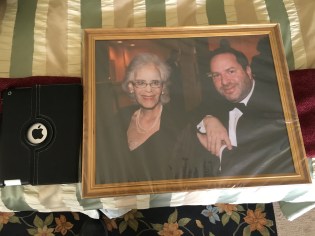
This past weekend, we converged on Cleveland and braved the snow (yes, you read that correctly!) to celebrate my sister Dena’s graduation from the Jack, Joseph and Morton Mandel School of Applied Social Sciences at Case Western Reserve University (TL:DR She’s a social worker). Friday night, as my father is wont to do when Estee and I come to Cleveland, invited a plethora of family friends over for Sha2016-05-15 16.09.21.jpgbbat dinner. As we transitioned from dinner into dessert, my father began speaking to the 20+ guests at our Shabbat table, something he doesn’t usually do. He thanked everyone there, and noted that while we were celebrating a truly joyous milestone, my mother’s absence was painfully obvious. He then told us how he had recently Googled “Sheila Radman Balk” and a picture came up on his screen, one he hadn’t seen before. This photo was from a gala for Lifebanc, an organization that promotes organ donation in Ohio. My mother was a volunteer for them, an organization that as a transplant recipient was near and dear to her heart (and her liver!). My father contacted the photographer and was able to get a high-resolution picture, and printed and framed it for me, my sister, and my aunt. We were shocked. I fought with every fiber of my being not to start bawling in front of everyone in the dining room. It was, and is, beautiful and absolutely perfect. As I was scared to bring it on the plane, it’s currently being housed in Cleveland for the time being. We’re not quite sure where the picture is going to be hung yet, but judging by how large it is, it will definitely be prominently featured in our home. Just to compare, on the left is my father’s iPad (NOT an iPad mini!). Thank you, Dad!

From Sadness to Joy, From Mourning to Celebration Yom Hazikaron/Yom Haatzmaut – 5776

291966_4000603485799_65008671_n

For me, Yom Hazikaron and Yom Haatzmaut are two of the most emotional day on my calendar. I would say our calendar, but I understand that there are Jews who neither celebrate nor care about these two days. While I would assume that none from this camp will be reading this, or even care about what I have to say, I’ll still be respectful of their opinion. Nevertheless, I find that the juxtaposition of Yom Hazikaron to Yom Haatzmaut is indeed significant. How can we properly celebrate what we have without first taking time to remember what we’ve lost in order to have it? Additionally, this sequence is part-and-parcel to the Jewish experience. Regarding the Purim story, we retell the dastardly plot of Haman the Wicked before speaking of the great joy that washed over the Jewish people of Shushan and beyond. In the Haggadah, we expound upon the miracles that the God performed for Bnai Yisrael during their exodus from Egypt. This occurs only after we recount their disgrace both as slaves and as the descendants of idolaters. Only after reflection can we begin celebration.

Yom Hazikaron for me brings memories of when I was in yeshiva. Although I lived in the Old City and was there during the Yamim Tovim and other popular tourist times, I cannot remember a busier day than Yom Hazikaron. That morning, I went with a few friends from Yeshiva by cab to Har Herzl. When I say went to Har Herzl, I really mean the cab driver took us as close as he could get before the onslaught of bumper-to-bumper traffic. We exited the taxi and began the trek to the cemetery. After about two minutes of walking, we heard the wail of the siren, and suddenly I witnessed a scene straight out of the videos I had only been privy to before in my day schools’ classrooms. The cars stopped, the drivers and passengers got out. Most stood up straight, some wiped tears from their faces. I know it’s annual event that might not be overly special to some, but it’s one that I’ll remember that for the rest of my life. We made it to Har Herzl, along with the thousands of friends and relatives of fallen heroes, as well as the throngs of others who had never met these brave individuals. We couldn’t help but be enamored by the tombstones we’d pass. The ones who grew up not far from us, the ones who were younger than us when they were murdered We heard stories that made us laugh, and many that made us cry. The Israel that I had enjoyed on my previous trips, the Israel where I lived, had been maintained by the Almighty and the kedoshim interred on Mt. Herzl.

Another defining moment came on the heels of the massacre at Yeshivat Mercaz HaRav in Jerusalem. Three days after the ruthless attack, the entire yeshiva picked up and moved to Mercaz Harav for night seder. Between the talmidim, rabbis, and chevrutot, there were over 250 of us there. The library windows, doors, floors, and bookshelves were still riddled with bullet holes. An informal gathering took place there as our Rav Avigdor Nebenzahl (our senior Rosh Yeshiva and then Chief Rabbi of the Old City) started to offer words of encouragement. What started with a group of 10 students quickly grew to over 100. The Kaliver Rebbe was there speaking through his own tears to the students of 1934149_1006951697440_6029_n.jpgYeshivat Yerushalayim L’Tzeirim (Yashlatz), the adjacent institution which serves as a feeder to Mercaz HaRav. Five of the eight students killed were enrolled there. We sang, and then heard remarks from one of the rabbis of the yeshiva. The way we arrived at Mercaz HaRav, and they way we left could not have been more different.

Something happens when the sun sets on Yom Hazikaron. We take off our clothes of mourning and put on festive garments. The day is transformed. It’s almost instantaneous. We celebrate the land that those who fell in battle dreamed of being a part of. We live on for them, and for those who have been killed for simply being Jewish in the Jewish homeland. And although this is not the manner in which they would’ve wanted to affiliate with us, they are singing, dancing, and rejoicing at the same time from their perches in Shamayim.

There’s a story about Rabbi Avraham Yitzchak Haohen Kook z”l being asked about his infatuation with the land of Israel. Rav Kook responded that he was a Jew who tried to model his way of life around the Torah. And if one looks inside the Torah, they will see that from Lech Lecha until Vezot Habracha, that the land of Israel is mentioned in every single Torah portion. That, explained Rav Kook, is the reason for his affinity toward Eretz Yisrael.

The connection between the Jewish people and the land of Israel is getting stronger and stronger, and I pray every day that this trend continues.

Whether you are zocheh to live in Israel, or dwell “besof maarav”, whatever you find yourself doing on Yom Haatzmaut, take a moment and thank Hakadosh Baruch Hu for the amazing gift of the land of Israel.

אִם יִהְיֶה נִדַּחֲךָ בִּקְצֵה הַשָּׁמָיִם מִשָּׁם יְקַבֶּצְךָ ה’ אֱלֹהֶיךָ וּמִשָּׁם יִקָּחֶךָ


Mother’s Day 5776-2016

Today, the nation is celebrating Mother’s day. I grew up with the message imprinted into my mind that every day was mother’s day, and I’m sure I’m not the only one who was educated in this manner. True, while not an explicit “yuntif” as codified in Jewish Law, today is the time that the rest of the country reflects on the woman (or women) who raised them, and there’s never a bad day for that.

Today, I think of my “mothers”, the women who raised me and continue to have an impact on who I am as a person.

I think about my grandmothers. My Grandma Idee z”l was a sharp lady who made the greatest potato knishes and “kmish bread” you’ve ever tasted. My Savta, is one of the most regal women west of the Mississippi. May Hashem bless her with many healthy years.

I think about my aunts that I am blessed with, both blood-related and not, who have been there to support my family. Often times, traveling a great distance at the drop of a hat.

I think about my mother-in-law who makes sure that I am always taken care of, and treats me as she treats her own sons.

I think about my great-grandmothers who I only knew for a short period of time, yet shaped the lives of my parents and their other grandchildren.

I think about the “circle of mothers” I am blessed to have in Cleveland who looked after me, just as my own mother looked after their children. They know who they are, and our families are blessed for having been brought together.

Primarily, I think my mother z”l. I cannot, nor would like to imagine the person I would be today without having her as a guiding influence in my life.  She was a master educator, an even more talented mother, and one of the most resilient people I’ve ever come in contact with. I could write thick volumes about what I’ve learned from her, both directly and indirectly, but I fear I do not have enough time, paper, ink, or space on my devices.

Rabbi Soloveitchik z”l delivered  a powerful eulogy for the Rebbitzen of Talne, the mother of his son-in-law (Tradition, Spring 1978), where he delineates the role that the Jewish mother plays in the lives of her children.  He defines the role of a dual mesorah, one received from the father (mussar avicha) and one received from the mother (torat imecha). The Rav explains that mussar avicha touches upon basics of torah learning: how to read a text, how to analyze and conceptualize, etc. This also covers the basics of how what to do and what not to. But as for torat imecha? Rabbi Soloveitchik explains:

“What is torat imecha? What kind of a Torah does the mother pass on? I admit that I am not able to define precisely the masoretic role of the Jewish mother. Only by circumscription I hope to be able to explain it. Permit me to draw upon my own experiences. I used to have long conversations with my mother. In fact, it was a monologue rather than a dialogue. She talked and I “happened” to overhear. What did she talk about? I must use an halakhic term in order to answer this question: she talked meinyana deyoma. I used to watch her arranging the house in honor of a holiday. I used to see her recite prayers; I used to watch her recite the sidra every Friday night and I still remember the nostalgic tune. I learned from her very much.

Most of all I learned that Judaism expresses itself not only in formal compliance with the law but also in a living experience. She taught me that there is a flavor, a scent and warmth to mÏfzvot. I learned from her the most important thing in life – to feel the presence of the Almighty and the gentle pressure of His hand resting upon my frail shoulders. Without her teachings, which quite often were transmitted to me in silence, I would have grown up a soulless being, dry and insensitive.

The laws of Shabbat, for instance, were passed on to me by my father; they are a part of mussar avicha. The Shabbat as a living entity, as a queen, was revealed to me by my mother; it is a part of torat imecha. The fathers knew much about the Shabbat; the mothers lived the Shabbat, experienced her presence, and perceived her beauty and splendor.

The fathers taught generations how to observe the Shabbat; mothers taught generations how to greet the Shabbat and how to enjoy her twenty-four hour presence.”

My father has taught me much. Among other things, he prepared me for my bar mitzvah, taught me how to don tefillin, and much of the ritual knowledge I have today stems from years of hearing him practice, both eloquently and effortlessly. The torat imecha comes in the form of a story, one that I delivered at her funeral and will repeat here.

Long ago when I was in the 4th grade, one day during birkat hamazon I happened to have been talking or misbehaving rather than reciting the brachot with the rest of my class. After my insubordination, my teacher took it upon herself to punish me by having me stay back from recess and copy down birkat hamazon verbatim. I returned home that afternoon dejected, probably less about my assignment and more about missing prime four-square or “wall ball” time outside with my peers. After doing her best Sherlock Holmes impression to uncover the reason as to why I was upset, when I told her what transpired, she was appalled. She immediately called the principal, who was a family friend. She told him that this punishment was unacceptable. If I was misbehaving, by all means was I to be punished, but not in a manner such as this. I remember her saying distinctly “We want Willie to love the torah, not to be burdened by it.”

That was that

The details of what followed are a bit fuzzy, but my mother’s message was succinct and poignant. 

To the mothers out there, thank you for all that you do.

To those with a mother who is no longer with us, cherish the moments you had together.

To those who are yearning to be mothers, may the Almighty bless you with many healthy, beautiful children.  


“Not Since I Left Dagda…”

For most of my life, I was ignorant. I had no idea. Oblivious. It wasn’t hidden outright, talked about in hushed tones, or swept under the rug.

I discovered that I had family in that perished in the Holocaust while still in high-school when I encountered a plain red, three-pronged folder. Originally thinking it was a long forgotten graduate school assignment of my mother’s, I didn’t think much of the find. Only when my father told me what this actually was, did I begin to show any curiosity whatsoever. The decades-old document that I had unearthed from the bookcase in my living room was the autobiography of my great-grandfather, Harry (Israel) Chanen z”l, one that he wrote along with my great-aunt. I never had the privilege of meeting Grandpa Harry, as my father and his siblings called him, but I am lucky enough to be one his great-grandchildren who bear his name (William Israel). At the beginning of the book, when writing about the members of his extended family, he lists his father’s family and their whereabouts next to their names. X settled in America, Y moved to Israel, etc. But as I looked at the name of a cousin, my heart sank. Uriah Chanen: murdered by the Nazis. I sat transfixed as I read that statement over and over again. I did not possess a naive assumption that somehow my entire extended family had escaped the Nazi death machine, yet this revelation hit me like a freight train. Every time I visited to Yad Vashem or perused the online database they maintain, I searched for family members and found nothing. This time, I had a name: Uriyah, and I was determined to find him. After searching through a litany of interesting and unusual variations of spelling, I did just that.

Uriyah Hanin was born in Dagda, Latvia in 1875 to Leib. He was a merchant and married to Hinda (nee Lev). Prior to WWII he lived in Dagda, Latvia. During the war he was in Dagda, Latvia.

Uriyah was murdered in the Shoah.

This testimony was added to the Yad Vashem archives in 1957 by his daughter, Ahuva Brandwein, a resident of Kfar Saba. Uriyah wasn’t the only Hanin in the database. His children listed there are Michel (Misa), Sara Riva, and Leah. Michel was married to Leah, and they lived in Dagda where he too worked as a merchant. The couple had a son named Chaim. Sara Riva was married to Yisrael (Zilu) Erenstein, and they had one daughter, Hinda. They lived in Tukum, 40 miles east of Riga and  205 miles from Dagda. Leah, Uriyah’s youngest child listed, was a student. There was also Yankel Hanin, a different first cousin of Grandpa Harry’s, and his wife Genda and children Mere and Bar. And then there was Avraham Hanin; Reina Hanin; Samuel Hanin; and Tzila Hanin. They, along with the remnant of Jews in Dagda and surrounding towns in Southwest Latvia, were expelled to the Dvinsk Ghetto in July 1941. They were murdered by the Nazis in the Pogulianka forest in Lithuania one month later.

I set out to uncover information about one of my great-grandfather’s cousins who died al kiddush Hashem. Instead, I found fifteen more relatives who earned that same moniker. And there may be others. The database listed more Hanins, some who I know ultimately escaped Dagda, and others whose fate I still do not know, and most likely, never will.

תהא נשמתם צרורם בצרור החיים

Clockwise from the top: (1) Michel (Misa), Leah, and Chaim Hanin Hy”d (2) One of the three synagogues in Dagda (3) Dagda sign today (4) Monument in memory of the Dagda and Vishki (Latvia) Jewish communities Hy”d (5) Pre-war Dagda (6) Pre-war Dagda