
Chanukah 5777 – Divine Nature

FullSizeRender.jpgThe miracles of Chanukah transcend the laws of nature, derech hateva. Rabbi Gavriel Zinner, author of the encyclopedic series Nitei Gavriel and rabbi of a congregation with that same name, explains that Chanukah is the time on our calendar that teaches us that nature has no power without Hashem. He quotes the Chiddushei HaRim that the thought process of the Yevanim was solely based on derech hateva. It never occurred in their minds that there could be a divine force that could combat the natural order of the world. This is the exact koach of Ner Chanukah, going above and beyond nature, lemaalah min hateva. This enlightens and showcases to Klal Yisrael that nature has no power without divine placement. This, notes Rav Zinner, is the exact opposite of the logic of the Greeks, who wanted to tie everything to derech hateva. The natural order of the world is an ironclad belief system, but when it comes to Hashem, the Being that set derech hateva in place, all bets are off.

As Jews, we know that the Almighty is capable of bringing about unbelievable miracles in our days, just as He did in the times of the Chashmonaim and before. Nevertheless, we are commanded to not rely solely on miracles to save us. This wily band of Jews fought valiantly, all the while not knowing if they’d be victorious, let alone even stood a chance against the ferocious onslaught of the Yevanim. Hashem, in His mercy, aided the Chashmonaim in trouncing the Greeks, and in doing so, obliterated the Greek notion that the world relied only on derech hateva. For Hashem, there is no derech hateva. As we say in Al Hanissim, Hashem “delivered the mighty into the hands of the weak, the many into the hands of the few, the impure into the hands of the pure, the wicked into the hands of the righteous, and the wanton sinners into the hands of those who occupy themselves with Your Torah.” Where is the derech hateva? What’s happened to the nature of the world? Nature would teach you that the mighty would triumph over the weak, or that they would prevail by outnumbering them. Nature would laugh in your face at the mere possibility that these dominant, wanton sinners would be clobbered by a puny group of Torah scholars, whose time was spent more in the house of study than on the battlefields. While the Greeks, and the rest of the world looking to destroy the Jewish people are left scratching their heads, we stand are able to stand tall. We know that to go lemaalah min hateva, to go above and beyond the laws of nature, is precisely the derech hateva of the Almighty.

Vayeishev 5777 – In Good Times and Bad

mountain-road-wallpaper-8.jpg

If you think the relationship you have with your siblings is poor, take a look at how Yosef and his brothers get
along in Parshat Vayeishev. The brothers, who can sense that this dreamer is the apple of their father’s eye, do not exactly relish being told by their least favorite sibling about how his dreams are all about them bowing down or serving him. Things intensify to the point where the brothers plot to kill Yosef, and are only deterred by the eldest brother, Reuven, that maybe this is not the best idea. Rather, they sell Yosef into slavery and tell their father that he’s been shredded to pieces by a wild animal.

Yet, throughout this ordeal, Hashem is with Yosef, guiding him. The Torah tells us that (Bereishis 39:2) “The Lord was with Joseph, and he was a successful man, and he was in the house of his Egyptian master.” He transitioned into a successful man from the lowly slave that entered Egypt not long before. Nevertheless, despite this success, he was still thrown into jail. After Yosef spurns the continued advances of Potifar’s wife, she turned around and made false claims about him. The sentiment in the  is the same: (39:21) “The Lord was with Joseph, and He extended charisma to him, and He gave him favor in the eyes of the warden of the prison.” There is a massive practical lesson to be learned from these two events in the life of Yosef, a message that we all know but don’t always remember. Just as Hashem was with Yosef in his time of success and struggle, so too is He with us in our times of great and not as great.

There’s a great story of Rav Noach Weinberg z”l trying to recruit a student to learn in yeshiva, yet the student rebuffs the offer and responds “God and I are tight.” He proceeds to regale Rav Weinberg with a tale of him riding his motorcycle on a winding mountain road when suddenly, a massive truck came from around a corner, barrelling straight toward him. The man was forced off the road, off the side of the mountain. He’s plummeting toward earth when as suddenly as the truck appeared, a tree appeared in front of him. The man grabbed onto the tree branches for dear life, able to hold on to watch his bike go up in flames below. He was able to walk away from the incident unscathed. “God put that tree there for me, and saved me”, said the man. Rav Weinberg was intrigued by the story and without missing a beat responded “Yes, but who do you think sent the truck toward you?”

As they say, there are no atheists in a foxhole. It’s easy for someone to see the hand of God when their back is against the wall. In Judaism, we have a bracha of Dayan HaEmet for somber occasions, but we also have a bracha of Hatov Vehameitiv, when good fortune is graced upon us. At times, it’s more difficult to stop and recognize Hashem’s presence in our life when things are great at work, at home, and everywhere else. I don’t need anything! Hashem was with Yosef at all junctures of his life, good and bad. We say in Ashrei “Karov Hashem lechol kor’av, lechol asher yikre’u be’emes”, Hashem is close to those who call to him in sincerity. It doesn’t specify whether times are good or bad. The God we call out to in times of trouble is the same God that gives us more during our times of plenty. May He continue to always guide and protect us. 

Chayei Sarah 5777: Derech Eretz Kadmah LaTorah and Thoughts on Giving Thanks

2012-11-22 16.46.30 copy.jpg

Thanksgiving one of America’s favorite holidays, loaded with food, family, and loads of seemingly “yehareg v’al yaavor” holiday traditions.  I look at this particular legal holiday bearing in mind the challenges and bumps in the road that have peppered my own life, yet I still find an overwhelming amount of things to be thankful for. 

-I do not understand everything that Hashem does, but so thankful He takes care of me.

-I’m thankful to be part of amazing, supportive families that will do anything at the drop of a hat.

-I’m thankful for having an amazing wife, my greatest cheerleader, who encourages me to be the best person I can be.

-There are numerous things I wish I had that I do not. Yet, next to the checklist of what I do have, I am thankful to be so incredibly lucky.

-I’m thankful for a Cleveland Cavaliers championship.

-I’m thankful for living in a democracy. I do not agree with protests or demonstrations, but I am indeed thankful for the right to have them and not be persecuted. I have not always rejoiced in the outcomes of our democratic elections, but I am undoubtedly thankful for them. 

-I do not always agree with what’s going on in the State of Isreal but thankful that there is one. There are plenty of people alive today who lived in a world where that was not the case, those who have seen the consequences of what that world looked like. 

There’s something nice about the entire country coming together, if only for one night, to recognize what’s important in life and to be thankful for it. As Jews, we are commanded at various different times to give thanks. When we encounter a dangerous scenario, we recite the bracha of “Hagomel lechayavim tovot shegemalani kol tov”, that we thank God for bestowing His kindness upon them in a time of need. Many people know this blessing today as it’s also widely recited after travel across the ocean.

Furthermore, Jews thank Hashem not only for saving us from peril, but actually offer our thanks and appreciation every single day. Upon arising in the morning, the first thing we are to do is recite Modeh Ani, literally thanking the Almighty for restoring our soul to us that day, having great faith in all of us that we can work toward accomplishing the tasks He’s set forth for us. Another such benediction of thanks appears in the Shemoneh Esrei with the Modim prayer, an entire paragraph where we thank Hashem. While the chazzan recites this prayer, the congregation is to say a different version of Modim. The Abudraham comments that when it comes to giving thanks, this is something that cannot be done for us by an emissary. We must each individually offer our own message of gratitude.

Giving thanks ties very nicely into derech eretz. How wonderful does it feel when someone does something great for you? How wonderful does it feel when we do something for someone else? Saying thank you is a natural response in line with derech eretz. It’s the proper thing to do. Yet, it doesn’t always happen, and not only because actions can sometimes be done in anonymity when the giver is not always known to the recipient. If someone performs a great chessed for you on countless occasions, will you only thank them once? Of course not.

Rav Shlomo Wolbe, the famed mashgiach and mussar giant, sheds light on instances of the primacy of derech eretz as found in Parshat Chayei Sarah. 

Rashi explains (Bereishis 24:42) from the Midrash that Rav Acha recounts that ordinary conversation of the servants of the Patriarchs are more dear to Hashem than the Torah of their sons. The proof for this is that section dealing with Eliezer is repeated in the Torah, while many other fundamental Torah missives and messages were given only through hints, rather than explicit statements.

What is is about the words of Eliezer that are so dear to Hashem?

Rav Wolbe explains that the words of the servants of the Avot are used to convey guidelines of derech eretz. Eliezer’s actions and expressions were rooted entirely in derech eretz, which is why they were considered so important that they were worth repeating.

Tanna D’vei Eliyahu (1:1) explains the common phrase, “derech eretz kadmah laTorah” that derech eretz precedes Torah. Rav Wolbe connects this idea to grocery shopping. Just as one needs a bag to hold their produce or a carton to hold their eggs, Hashem applies this idea to Torah. The very vessel charged with “containing” the Torah is derech eretz. Derech eretz is defined as the actions and behaviors that a person should recognize as proper without having to be taught. Before a person can properly learn Torah, they must have a proper grounding in seichel (common sense) as to what is right and what is wrong. One who lacks proper derech eretz is compared 2013-01-20 12.07.12 copy.jpgto by our sages as worse than a dead animal (Vayikra Rabbah). Derech eretz enables someone to become a gadol baTorah, a true Torah giant.

The importance of derech eretz can be seen later in the parsha as well. When Eliezer returns to Yitzchak with his bride Rivka, the Torah tells us (24:67) that Yitzchak brought her into the tent of Sarah, his mother. Targum Onkelos writes that only after he saw that her middot (character traits) were identical to those of his mother, did he take her as his wife.

This seems puzzling. In the previous pasuk, Eliezer explains to Yitzchak the entire story of his journey. Rashi writes of the various miracles that occurred on the way (shortening the length of his trip and his tefillot being answered unbelievably quickly). What else did Yitzchak need? Weren’t those amazing miracles enough for him to seal the deal, and take Rivka as his wife? What difference do her middot make in the face of these open miracles?

Rav Wolbe answers that even if these miraculous events all pointed one way in proving that she was his match made in heaven, the deciding factor needed to be the character traits of this individual. Incredible events of hashgacha, Divine providence can sometimes cloud our judgement and deviate our minds in terms of what is truly important. Derech eretz is so vital that it comes before Torah! One can spend their entire life devoted to learning Torah, yet if they lack the respect and human decency to be kind to their fellow, it’s as if they have learning nothing at all. Proper derech eretz is the foundation of Klal Yisrael and that’s exactly why Yitzchak needed to be sure of Rivka’s middot before agreeing to marry her.  

Derech eretz is the lifeblood of the Jewish people. Thanksgiving may come only once annually, but derech eretz is an everyday mandate.

19 Cheshvan: A Very, Very, Very Fine House

The picture that you see below is what has been the Balk homestead for the last 9.5 years.

f_3803404.jpg

And I hate it.

It all started back in 2007 when my parents were looking for a new house. Finding a house with a first-floor master bedroom for my mother, while staying in the same district for my sister’s schooling was a tall order. Yet, they found a house that fit their needs, and quickly pounced on the property the first day it hit the market. I was less than excited about the new house, a house that was significantly farther from the shuls I’d walk to on Shabbos and Yuntif. I’d try and find every flaw of the home and point it out to my parents: The kitchen is so ugly! The bedrooms have no lights! Do you REALLY want to live on the corner of one of the biggest, most annoying intersections in Shaker Heights? Sadly for 12th grade me, those complaints fell on deaf ears. I packed my room in early June as I was headed to camp later that month. I’d call from camp and dial a number that was no longer in service. I put the new phone number in my phone as “New House”, a contact which remains in my phone today. When camp was over, I had five days until I left for the year to Yeshiva. My parents picked me up from the bus, and as we drove a different way home, I quizzically asked “Aren’t you going the wrong way?” To my horror, they were not. We arrived to the house, I shudder to say “home” because it felt nothing like home. The five days flew by and before I knew it, I was on the plane, first to JFK and then to Israel. At 35,000 feet, I finally came to terms with my parents’ new house. After all, the inconvenience it provided me melted in comparison to my mother getting her life and mobility back. I thought about the time it would take her to go up and down the stairs of the grand, two story foyer in our old house. I still can’t believe she’d do it a few times a day. It made my annoyance seem so obnoxious, so trivial. I’d remind myself of that tidbit every time I’d make the almost two mile trek to shul when I’d come home. Every step is a mitzvah, I’d tell myself, although it didn’t make the journey any easier.

A few Saturday nights ago, my father called me and told me that someone had put a bid on the house. It had been on the market for a little while, and I was happy that someone had taken interest in it. The catch was that they wanted to move in very quickly, as soon as possible. I booked a flight home the next day, and began packing and cleaning up my bedroom. I found so many amazing things from my childhood, artifacts that hadn’t been touched in nearly a decade. Old speeches I gave, pictures with friends, other wonderful souvenirs from my formative years.  Rejection and acceptance letters from colleges, that my mother had opened before I got a chance to do so. Meaningful, loving cards from my parents telling me how proud they were of me (and that I needed to clean my room). Items that shaped me into the very person I am today.

That night, I couldn’t sleep. As I lay in bed for the final time in my now “old” house, I tried to think about what it meant to me. The frustration wrought in the decision to move there, and the unknown in the decision to move out. And I immediately thought of my mother. It was her house. It was a beautifully open home, one that could not have been more perfect to host gatherings with throngs of people coming together (Sedarim, epic July 4th extravaganzas, her unbelievable surprise party celebrating her 5 year liver transplant anniversary). Her large bookcases from our old house miraculously fit into a perfect space, so perfect that people assumed we’d had these installed after we moved in. The house she’d come home to after various bouts in the hospital or physical therapy rehab, the one that would welcome her with open arms.

Ultimately, more than any of those other events, this house will be remembered by me as the house where we mourned my mother. The house where we were comforted in a time of great darkness and sadness. I’ll never forget the family, friends, rebbeim and others who came to pay their respects. I still get goosebumps when I think about Rabbi Penner, the dean of YU’s rabbinical school, flying in one of my rabbeim to visit us for the day. It’s been three years, but those are snapshots that will last a lifetime.

Our sages teach us that when mourning for a family member, it’s appropriate (when possible) for all grieving family members should observe shiva together in the house of the deceased. The home that someone has lived in is a place where their spirit continues to dwell after their passing. Although I can still find flaws with the physical structure, my mother’s spirit continued to dwell in that house.

But her spirit can also be found at the Cleveland Clinic. At Menorah Park. Park Synagogue. Bnai Jeshurun. Gross Schechter Day School. Fuchs Mizrachi School. The JECC. Heinen’s. Boris Kosher Meats. There aren’t too many places I visit in Cleveland that my mother’s neshamah didn’t touch, directly or indirectly. I don’t have to look too deeply.

These were the thoughts that ran across my mind as I stared at the ceiling of my bedroom on my last night at 2791 Chesterton Road. How could I sleep? By the time I finally learned to stop hating this house, my family didn’t even own it anymore.  All I wanted to do was cry. The house that I didn’t even want to move to had moved me to tears.

About this Week… – Lech Lecha 5777: The Immediate, Necessary Steps as exhibited by Avraham, Rachel, and Rav Nosson Tzvi Finkel.

As I walked into shul for mincha/maariv today, I was stopped in my tracks. There in front of me, next to the mechitza in the Beit Midrash, stood a large TV camera and microphone. Although I originally thought it was a new synagogue initiative to help improve the decorum of our tefillah betzibbur (which happens to be relatively good), the rabbi informed the mispalelim that the New York Times had sent a camera crew to the synagogue to document us for a piece they’re working on pertaining to how people in religious world were “coping” with the aftermath of the presidential election. Many of those present found this perplexing. This group of men and women gathering together for daily prayer was far from anything out of the ordinary, but it made me think about the premise of this journalist’s presence at our minyan. This week has been pretty interesting, to say the least. There are people across the country who are hurting, still transfixed over the election results, and I understand their shock. When there’s a communal consensus of suffering and shock, we as a people come together both to pray and remind ourselves that the Almighty is in control, and will ultimately seize the situation and end our misery.  What can we do? What should we do? To me, there are three steps that we must take at this moment: Believe in God, Daven, and Act.

The first step is to believe that Hashem has a plan and to trust in Him. It’s the most frustratingly cliche answer ever given, but it’s the truest of adages, one that we find spanning the gamut of liturgy and, and also nestled in Parshat Lech Lecha. Rav Shlomo Wolbe in his Shiurei Chumash brings a fascinating insight from this week’s sedrah, when Avraham is told by Hashem that he and Sarah will be blessed with a child (Bereshis 15:6). Now Avraham and Sarah weren’t exactly as young and vivacious as they once were, but Rashi explains that this blessing was a zechus for Avraham believing with complete faith that Hashem would indeed do what he promised to do (give them a child). Ramban is curious. Avraham believed that Hashem would make good on His word – That’s it?         Why should Avraham be rewarded for believing that something Hashem said would happen was actually going to occur? There has to be something more! Maharal explains that Avraham’s complete emunah is precisely why he and Sarah would be rewarded. Even though he had a direct message from God that he and his wife would have a child, true emunah is something that can be hard to muster up. Sarah Imeinu was old, and, as Rashi explains, didn’t even have the organs to even carry a child! Yet, Avraham was rewarded because of his emunah sheleimah, his complete faith that the unthinkable could occur because it had been willed by the Almighty. To summon up that level of belief for something so seemingly unlikely is nothing short of heroic, and we can see that other figures across the Torah grappled with this very task and acted differently.

Rashi explains (Bereishis 7:7) that Noach only entered the teiva once the rain began falling to signal the impending deluge. Why did he wait? He built the teiva for 120 years! Hashem told him the flood was going to happen! Why did he only enter the Ark once the rain started falling? According to Rashi, Noach lacked this complete faith in the Ribono Shel Olam, and didn’t believe that He would bring about such a punishment. What do we remember of Noach? He was ultimately drunk and embarrassed. Yet, even Moshe Rabbeinu was punished for not believing in to the word of God, as evidenced by his hitting the rock after being told to speak to it. Moshe was only the greatest leader the Jewish people have ever seen (no big deal). His life’s work was to lead the Jewish people through the desert to the promised land, and after only one hiccup he loses the chance of setting foot on that its holy soil. The message is clear: emunah shlaima is something that’s rewarded even though it seems trivial.

Our next step is prayer. The struggle for Avraham and Sarah to conceive is not the last time that our Patriarchs and Matriarchs dealt with issues infertility. One such experience was that of Rachel Imenu, whose yahrtzeit is marked this Shabbat, a day that is marked by intense tefillah. Rachel’s prayers are very important, and it is in her merit that Mashiach will ultimately redeem the Jewish people. Rachel cried to Yaakov that if she doesn’t have children, it’s as if she were dead (Bereishis 30:1).  Rav Avraham Schorr in HaLekach VeHalibuv on Sefer Breishis explains that because of this “chiddush” of Rachel being considered dead without children, Yaakov then took Bilhah, Rachel’s maidservant, and had a son. This child was named Dan, by Rachel, because Hashem had judged her and listened to her voice. Even though she herself had not yet given birth, she was the reason for Dan’s existence. Rav Schorr writes that Shevet Dan was no ordinary tribe of Israel. Shevet Dan was charged to bring up the rear of all the tribal encampments and was responsible for ensuring that everyone was where they needed to be. This is in line with the description of Rachel Imenu in Sefer Yirmiyahu, the Rachel who “cries for her children for they are not with her” and that because of her, “there is hope for your future, says the Lord, and the children shall return to their own border.” Rachel Imenu would cry, and Shevet Dan would secure the perimeter, and see to it that all of the nefashot of Klal Yisrael were never lost, always ending up in the right place. In this merit, in the zechus of Rachel Imenu and her tefilos, her yahrtzeit is a powerful day that is met with great prayer for anything that we need.

We now come to the final step: action. There is much to learn from the emunah of Avraham and the tefillah of Rachel. The belief that ultimately things will be alright, and the reality that at times, all we can do is pray. Nevertheless, there is plenty to take away from the actions and the struggles of these individuals. The parsha is named for the commandment given to Avraham to get up and leave behind the entire world he knows. The cynic will say that Avraham took with him his wife, nephew, their possessions, and those who they brought into the fold of monotheism, hardly leaving much behind. The cynic will speak up again and tell you Rachel finally was blessed with children of her own yet died while giving birth and was hastily buried along the roadside. Yet, a cursory glance at their actions in the Torah showcases the chessed Avraham and Rachel. These individuals did not wallow in the sadness of the low points of their lives. They didn’t only believe it would be good, or daven that things will work out.

They acted.

This call to action reminds me of a hero of mine who I was lucky enough to see with my own eyes only once, whose yahrtzeit also happens to come out on Shabbat. Natey Finkel was a regular American day-school educated boy, and he eventually grew into Rabbi Nosson Tzvi Finkel, the Rosh Yeshiva of Yeshivas Mir Yerushalaim. He was an individual who woulRNTFztl.gif.jpegd meet with scores of people and go on fundraising missions world-wide to raise money for his institution. He maintained a rigorous, rigid schedule which would be hard for anyone to keep, let alone a man confined to a wheelchair with a body racked by tremors and weakness stemming from Parkinson’s disease. Anyone who has seen someone suffering from Parkinson’s knows first-hand how debilitating it can be. Yet, Rav Nosson Tzvi did no
t sit idle, nor did he lament his lot in life. He was an individual that if you saw on the streets of Meah Shearim, you might assume to be a person with significant ailments, perhaps not capable of making a marked difference on his daled amos. Such an assumption would be egregiously incorrect. He was an absolute giant. For him to be able to sign his own name was an ordeal in itself. But this man was able to move past immense setbacks, and make a significant, palpable impact.  Rav Nosson Tzvi Finkel was a hero to me not only because of what he was able to accomplish, on behalf of his yeshiva (which he helped grow into the largest yeshiva in Israel and second largest on the planet) or even the Jewish world. It was the manner in which he did it; through pain, suffering, and tzaros.   He was an individual who didn’t not slow down until the day he died.

That is our charge. To act. Too many times do we sit back and feel comfortable hashtagging and signing online petitions rather than fight the fight in the trenches. It is incumbent upon us to not rest on our virtual laurels while there is still great pain and suffering. We must disconnect from our online soapboxes in order to effectively work on eliminating matters that divide us in order to bring about unity. We must come together.

None can be certain what lies ahead, but by working together, despite our differences, we can do our part to ensure that there is indeed “hope for our future”, as well as hope for our present.


Just a Regular Day?

I haven’t done the research, but I’d venture to say that for most people, the best day of the year is one’s birthday.

For most of my childhood, my birthday festivities would go as follows: I’d go to sleep the evening of February 28th (or 29th during the dreaded leap years) and all would be normal. I’d awake the next morning by being serenaded by my parents, singing the Beatles’ birthday song. My mother would remark, at least four times throughout the day, “I can’t believe you’re 12, it seem’s like only yesterday you were 11” or however old I or my sister were that year. I’d head downstairs and the entire house would be decorated with streamers and the other birthday decorations. There would be a special breakfast and dinner, a call from my grandparents who would be on the phone together. For the life of me, I couldn’t figure out how they could do that. The day would be incredible. My sister would receive similar treatment on her birthday, and at times, the birthday decorations would stay up until my mother and father’s birthdays, almost a month later.

September 26th is my mother’s birthday. Tomorrow, is my father’s birthday (Ironically, my in-laws are also a day apart). It’s weird celebrating one and not the other, so to speak. It’s strange waking up today I can no longer call her and give her birthday wishes. I missed the July 4th pre-birthday bash the year she passed away, as I was in Israel staffing an NCSY summer trip. I’ve kicked myself 1000 times for not being there. I always assumed I’d make the next party. I was even in Cleveland for her birthday shortly before her petirah, which fell on yuntif that year. I didn’t walk to the hospital to see her. I figured we’d have more birthdays together. Is today just another, regular day?

I’ve always been taught that Jewish tradition has an interesting view on birthdays. The Torah has one instance of a birthday, the birthday of Pharaoh, seemingly mentioned in passing at the end of Beresheet. We usually wish someone life of good health until the age of 120, the age of Moshe Rabbeinu at the time of his passing. As I remarked at her funeral, my mother passed away at 60, needing only half the time to complete her mission in this world. To those that knew her, it makes perfect sense.

There are those who believe that on one’s birthday, they elevated to a higher spiritual plane, and give brachot to tDisplaying IMG_7844.JPGhose around them. Some are big believers in this practice, while others are not.

Another idea that I learned, although the exact details remain a bit fuzzy, is that, for males, one should recognize the day of their brit milah in addition to their birthday, since that was the day that they were brought into the covenant of our forefathers. This is an idea that is stuck in my head today as I attended the bris of the son of one of our “Cleveland cousins”, helping bring happiness back to a day that seemed so hard to celebrate since my mother died. I know it’s only the secular date, and my mother’s Hebrew birthday falls out on Chol HaMoed Sukkot, but I’m not one to nitpick when it comes to seeking comfort.

We love you, Mom. It seems like only yesterday that you were here.


Mazel tov Meir & Sara!

IMG_7520.JPGThis past weekend was one filled with happiness, as we celebrated the wedding of my wife’s twin brother, Meir, and his new wife, Sara. A few people asked for a copy of my remarks from the Aufruf at the end of davening on Shabbat morning. Below is the Dvar Torah.
I wanted to speak today about the koach of listening. There’s a lot written in Sefer Devarim, Moshe Rabbeinu’s final mussar shmooze to Klal Yisrael, about how important it is to hear, to listen to the words of Hashem. The crescendo of this message was read last week with the Shema, but it continues into our parsha, Parshas Eikev. You don’t have to go far into the sedrah to see it: The first pasuk, vehaya eikev tishme’un es hamishpatim ha’eileh ushmartem veasisem osam, that because you listen to the words and laws of Hashem, you will be blessed. It’s set out so clearly for us, if we hear God’s message and take it to heart, we will be privy to all sorts of bracha that was afforded to our ancestors. Children, good crops, flocks of livestock, health, dominion over all who pursue to destroy you, etc. It seems like a pretty good deal, no? We follow Hashem’s mitzvot, and we’ll see all these great things happen to us. Now the Jewish people have been no stranger to suffering, yet at the end of the day, the word of God is something you can take to the bank. We hear the messages over and over again: listen to God, and everything would be good. Why the reiteration? Chazal make a point of telling us that the Torah is so succinct and calculated, that there’s nothing extra included! What’s the reason we’re hearing this message on repeat? I think the answer is, that simply, we need to be reminded. It’s not an extra reminder, but every juncture where this comes us is an opportunity for us to put this mandate into action. We know what we’re supposed to do, but we don’t always do it, and we need a glaring alarm every so often to keep us focused. There are times when it takes an even greater level of understanding. Let’s travel back to Parshas Yisro. The parsha begins Vayishma Yisro, and Yisro heard. Rashi immediately asks, what, pray tell, was it that Yisro heard? He answers that Yisro heard about Yetzias Mitzrayim and the war with Amalek. The only problem is, that Yisro wasn’t the only one who heard about these events: the entire world did! We recount in Az Yashir that the inhabitants of Philistia were gripped with terror, the chiefs of Edom were confounded, and those who dwelled in Cnaan had melted in fear. Amalek heard what happened and wanted to knock Klal Yisrael down a peg or two, and still attacked them! What was so special about Yisro? Yisro took action. It wasn’t enough that he heard about what Hashem did for Bnai Yisrael, he stood up and said “this is where I need to be” and cast his lot with the Jewish people. We’re standing now on the cusp of Rosh Chodesh Elul, and the sefarim hakedoshim tell us that on Shabbos mevarchim for Elul that the world starts to tremble. We can take this message of Yisro and apply it to our everyday lives. Starting next week, we begin to sound the shofar at the end of davening, as we do all Elul long. It’s done to remind us that Yom Hadin is approaching. Not to serve as a reminder that we need to clean the houses for our out of town guests, or plan our menus, or remember to get the apples and honey hear the shofar on Rosh Hashanah, but to remind us to take stock of the past year, and do teshuvah. We say “Ashrei HaAm Yodei Seruah, blessed is the nation who knows what the shofar means”, who knows what it causes us to do. Ideally, we should live in a world where when we hear the shofar, we can’t think about anything other than repentance. We hear, and we internalize. The Jewish people don’t have Naaseh or Nishmah, it’s the two together that make it work. This is the exact message I’d like to leave my brother-in-law with as he embarks on his journey into marriage to our future sister in law, Sara. Listening to each other, and acting upon what you hear won’t necessarily ensure a 100% smooth marriage, but I can’t think of a better word of advice. As Rabbi Lamm said to his children, Sara (of blessed memory) and Rabbi Mark Dratch, under the chuppah, from Sefer Bereishis, “Kol asher tomar eilecha Sara, shma bekolah, that whatever Sara tells you to do, listen to hear voice.”

Liver Day

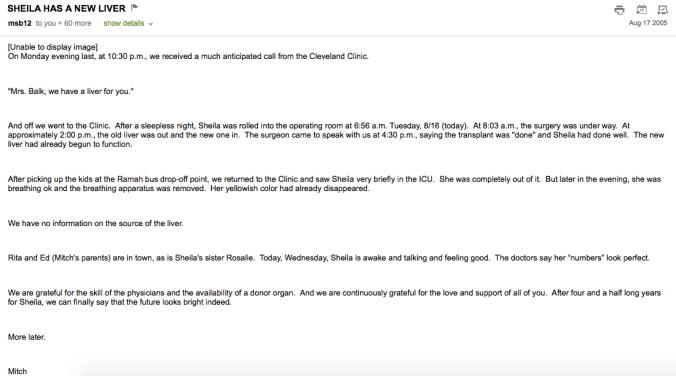
Screen Shot 2016-08-16 at 10.01.06 PM.png

Right now, I’m on vacation with my family and its very fitting that we’re all together. You see, August 16th a very special and auspicious day for the Balk family, not only because it was my grandmother’s birthday. My mother had been placed on the transplant list on June 29, 2005, after years of living with a damaged liver now forced her to need a new one. My sister and I were at camp, away from my parents during this trying time for our family. I don’t know what it was like for them back in Cleveland, but for me, up in the rural cottage-country of Ontario, every day brought a sense of anxiety, excitement, and disappointment. Anxiety because I was a 16 year old who researched organ transplants for months and who knew the list was long and that some patients die while waiting. Excitement for the possibility of my mother getting a new lease on life. Disappointment because I waited every single day of camp for that phone call or email or message from the camp office or fax (remember those?) and it never came. The summer of 2005 was my last as a camper, as I was in the oldest age unit, which typically adds an extra emotional bent to the two sessions at camp (on top of everything else that I was going through!).  On the final morning of camp, after staying up all night and saying my goodbyes, I boarded the bus and bid farewell to my summer home. We passed through the US-Canada border without any hiccups and pulled into a rest stop in Angola, NY, one that the bus stopped at on the way to and from camp each summer. I had finally stopped crying after thinking back to my previous years as a camper and how they were now over, in what seemed like a mere instant. I went into the rest stop and picked up a pay phone (again, remember those?) and called my house, as I always did on the way back from camp, to let my mom know our ETA. I found it strange that there was no answer. Usually, my mother was home preparing our post-camp feast. I found it even more peculiar that neither one of my parents had answered their cell phones. I wasn’t concerned, just found it odd. I got back on the bus and began eating my newly procured snacks  when Deborah Kaufman ran to the back of the bus where I was seated and handed me a cell phone. “It’s your dad.” I assumed he saw the missed call on his cell phone from a random New York number and figured we were trying to tell him we’d be another few hours. But I couldn’t believe what he told me. “Mom got a liver! She’s in surgery now and By the time you get home, we can go see her.” I don’t know what I did next other than begin bawling. The rest of the ride was an absolute blur. We got home and eventually made it over to the ICU where my mother was recovering. She was on the transplant waiting list for less that 2 months, and had still been working the entire time, two incredible facts. August 16th brings about memories of an entire community of caring, a community that still amazes me with how incredible they were, and still are.

I don’t know how many people have gotten calls that changed their lives forever. Sometimes, the news on the other end brings sorrow and pain.

I’ve been a staunch supporter of of organ donation in the Jewish community, and it’s amazing to see the work that organizations such as Renewal and HODS have been doing. I know that not everyone is comfortable with signing on to be an organ donor. I implore you to make an informed decision. Do your research. Speak to your doctor and/or your rabbi. I know it’s something that many would rather not think about, but you can’t fathom what it feels like for those on the other side. That little box on your driver’s license goes a long way. (Just to reiterate, be informed!)

I’d be lying if I said the next 8 years were the easiest ones for Sheila Radman Balk, but I shudder to think about how different this story would’ve been had she not received a phone call from the Cleveland Clinic at 11:00 pm the night before her transplant.

Hodu L’Hashem Ki Tov.

The Last Tisha B’Av Ever (5776-2016): Almost Complete, Yet Significantly Incomplete

Okay. Maybe the title is a little bit of a stretch, but you never know, right?

For me, the most meaningful Tisha B’Av experiences came when I commemorated this somber day while in Israel. We read Eicha at the Haas Promenade in Jerusalem (The Tayelet). It was so incredible the first time I experienced it on a summer trip in high school that when I staffed a summer trip years later, we brought our entire group there. We weren’t the only ones there, with good reason. The Tayelet provides a breathtaking view of Jerusalem. At night, it’s wonderfully illuminated. Yet, as beautiful as it is, it is glaringly incomplete without the most glorious of structures: our Beit Hamikdash. On my second Tisha B’Av night at the Tayelet, I told the program participants to look out at the city in front of them, and to take in the beauty and imagine that landscape as a massive jigsaw puzzle. Then, I asked the participants how it would look if the final piece of the puzzle was missing, rendering the project unfinished. How would they feel? What would they do?Some answered the picture would look complete enough. Some responded they’d make do without the final piece, and revel in the rest of their near perfect accomplishment. Yet, the overwhelming sentiment expressed was one of frustration. Knowing there was so much of the work completed was nice, but without the final piece, the puzzle wasn’t nearly the same. Almost complete, yet significantly incomplete. The situation posed to the program participants was not one made up on the spot, nor one made up at all. The Israel that we have today is truly amazing, but without the Temple, it’s not a finished product. Any slew of buildings can be constructed, but without the Beit Hamikdash, Jerusalem, Israel, and all of us are lacking. 

But in reality, there are powerful questions are on my mind, ones that I have a hard time myself answering:

Do I care about the Beit Hamikdash being rebuilt?

Do I mean it when we say I want it to be rebuilt?

Do I daven for it on my own, outside the framework of our fixed, set prayers?

Am I ready for Mashiach and the new Beit Hamikdash?

Some of these questions are easier to answer than others. I think I genuinely care about the Temple being rebuilt. Although there are times when my kavanna wanes from where I want it to be, I do mean it when I recite portions of our sacred liturgy where this inyan is discussed. Other than Mincha on Tisha B’Av and being inspired and comforted by the Nachem prayer in the Shmoneh Esrei, I can probably count how many times I’ve singled out the rebuilding of the Beit Hamikdash among the other pleas contained in my individual bakashot. Finally, I, along with many of my peers, aren’t ready for Mashiach to be here, but need this redeemer more than ever. The world is ready for the suffering to cease and have answers to the most jarring, painful questions. Yet, when it comes to living our lives as they were when the Temples first stood, that may be an area where we are not as well-prepared at the moment. But we still want. We still mourn. We still cry out. We take solace in the fact that we have the State of Israel, even without a Beit Hamikdash at the moment. Nevertheless, even with the modern-day splendor of our Holy Land, we still yearn, now more than ever, whether we’re ready or not. If the building of the Beit Hamikdash will bring an end to our communal tzar, whenever it comes, we will be ready.

Baruch Menachem Tzion U’Bonei Yerushalaim!


Akiva Nechamtanu – The Explanation

Akiva Nechamtanu.

People have asked me what the meaning is behind the name of this blog. It stems from a tale at the very end of Masechet Makkot. The story goes that Rabban Gamliel, Rabbi Eliezer ben Azaryah, Rabbi Yehoshua, and Rabbi Akiva were walking together in Jerusalem. When the group made it to Temple Mount, they saw a fox scurry out of the exact location of where the Kodesh HaKodashim once stood. Three of the rabbis began to cry, while Rabbi Akiva began to laugh. The teary triumvirate looked at Rabbi Akiva and asked what it was that he found to be funny about a fox running through the ruins of the holiest site in our tradition! Rabbi Akiva turned the tables and asked his three companions why they were crying, and they responded that their sadness stemmed from the verse in the Torah which states that any “Zar” or outsider who enters this holy place will be put to death (Bamidbar 1:51). Now, not only is the building no longer standing, but there are animals living there! Rabbi Akiva responded that for this exact reason did he laugh, and supports this claim with a plethora of evidence from the Neviim. He brings the verse from Yeshayahu (8:2) which connects the testimony of two prophets, one from Uriyah and one from Zechariah. Uriyah states (found in Michah 3:12) that Jerusalem will be plowed as a field and desolate, while the nevuah of Zechariah 8:4 says that old men and women will yet sit in Jerusalem. Rabbi Akiva mentions that the prophecy of Uriah was from the time of the first Temple, while Zechariah’s was from the second Temple, and the latter would only be fulfilled after the former took place. Now that this first prophecy had come true, with Har Habit reduced to rubble, Rabbi Akiva knew that, one day, the grandeur would be restored, and all would be right in the world. His colleagues respond “Akiva Nechamtanu, Akiva Nechamtanu”, “Akiva, you have comforted us. Akiva, you have comforted us.”

There are two reasons why the above account is my favorite story found in the Talmud to date. The first reason is because it shows me the immense strength of Rabbi Akiva. These four Torah giants are walking together and see the ruins of the Beit Hamikdash. Imagine the trauma, the memories, the raw emotion. It renders three of them to break down crying. Only Rabbi Akiva had the foresight to muster up the ability to laugh, to realize that yes, it may be painful at this moment, but we will yet have our day. There will be a time when this place is once again hallowed with a holy temple, where Jews of all stripes will come together. To keep that in mind in such a dark time is truly remarkable.

The second reason may be a little more obvious. My Hebrew name is Akiva. Rabbi Akiva has served as a sort of personal hero to me since the time I first learned of him. I am named for my maternal grandfather, William Radman z”l (Akiva ben Yehoshua), whose 31st yahrzeit happens to be today. I’ve been doing a lot of thinking of him over the last few years. He is someone who I never merited to meet, yet heard so much about from my mother (A”H) and my aunt (tibadel lechaim tom ve’aruchim). I cherish the pictures I have of him, and the remarks he gave at my parents’ wedding which were recorded on video. It’s hard to miss someone who you’ve never met before, someone you never got to know first hand.

I find it very appropriate that his yahrzeit falls in the time period leading up to Tisha B’av, a time when world Jewry is thrust into mourning. We grieve for the losses of our two holy Temples, among a myriad of other heinous events that historically occurred on this day, and every year we come up with the same quandary. The churban happened so long ago: how is it possible to properly feel this sense of loss when we never knew what we had in the first place? It’s the feeling that grips me when I think about the 9th of Av and when I think about my grandfather. I feel the sense of loss, even though I don’t know exactly what I’m missing out on.

Yehi Zichro Baruch.

May we merit to see Tisha B’Av become a day of celebration, complete with the building of the Third Temple bimheira beyameinu.