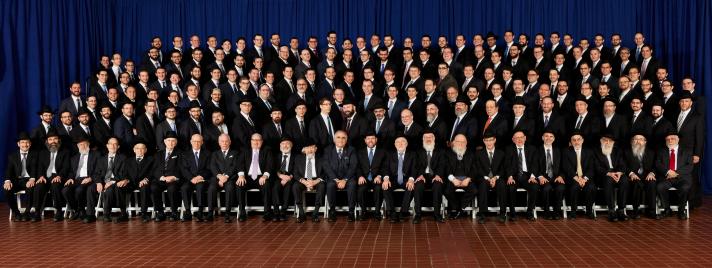

@YUNews Poster Rabbi!
There exist in our lives days that we will never forget. Happy occasions, somber ones. We’ll remember our feelings. The sights and smells around us. It’s as if the world is standing still. For me, and 130+ of my friends and colleagues, yesterday was one of those days. It was the day in which we were recognized for our years of study and completion of rabbinical school. Granted, some have long been finished while others are scrambling to complete a myriad of bechinos in a timely fashion. Yes, the ceremony itself could’ve been more succinct and to the point. It is also true that the seats in YU’s Lamport Auditorium could not be more uncomfortable. Yet, it was one of the most exhilarating and exciting days of my entire life.
 The moment from the Chag HaSemicha that sticks out the most to me was the special award presentation made to Rabbi Hershel Schachter. This year marks Rav Schachter’s 50th year teaching Torah at Yeshiva University, an unbelievable accomplishment. But what made it truly special was the Sefer Torah that was commissioned in his honor and presented to him during the ceremony. One son carried the Torah down the aisle, flanked on both sides by a brother, until they reached the stage. They ascended, along with many of Rav Schachter’s granchildren, sons-in-law, and mechutanim, and the Eitan Katz led the entire room in song. Rav Schachter is a walking Sefer Torah, and it’s only fitting that he be presented with a Torah scroll, one that will be housed mere feet from his seat in the Glueck Beis Medrash.
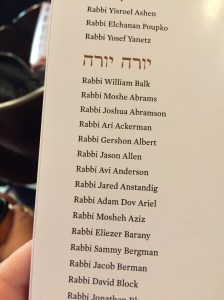
Graduating FIRST on the list of Yoreh Yoreh musmachim. After weeks of joking about this with my family a clerical error somehow placed me there (or did it?).
I cannot truthfully refer to Rav Schachter as my own “rebbe” as I was never regularly in his Talmud shiur nor seeked his counsel on various life issues. Yet, more poignant to me than the shiurim of his I’ve attended or halachic questions I’ve posed to him is the fact that the while he may not have been my “rebbe”, he served this role to most of my rebbeim. Had Rav Schachter never become a staple of Yeshiva University, his thousands of talmidim would’ve no doubt learned Torah from another master, yet I’m convinced the very landscape of Mordern Orthodox Jewry would be vastly different.
After the Chag and following a lovely reception with my family, Estee and I raced over to a different kind of celebration. My shul’s dinner (my apologies for lack of pictures, as our phones had died and the pictures haven’t been posted just yet) was a celebratory event recapping the successful, wonderful tenure of our senior rabbi, Rabbi Shmuel Goldin, and his wife Barbara, and the indelible mark they have stamped on the Englewood Jewish community (and beyond). The significance and symbolism of these two events occurring just hours apart is not lost on me. The new musmachim sat and heard about the power of what we can accomplish in our field. Later on, I was privy to see just how one such figure went about doing that. Although Rabbi Goldin will have only been my rav for a short period of time before he makes aliyah, I’m reaping the reward for his 33 years of ingenuity, making our synagogue into the very community that it is today. Much like Rav Schachter, Rav Goldin’s reach is incredibly broad, extending far beyond the daled amos he is currently situated.
Some of my colleagues who were celebrated yesterday are well on their way to impacting their communities and the broader Jewish community at large, while others may be situated in a more nascent state. The potential exists for all of us. Yesterday, I watched to particular rabbis, among others, be recognized for their years of maximizing their potential in their given fields. It is my wish that we, the new musmachim, are able to merely approach to the standard they set for rabbinic excellence.
Mazel tov!
Click here to see more pictures from the 5777 Chag HaSemicha.


 Shabbos Zachor holds a special place in my heart (especially when it falls out of Parshas Tetzaveh). No, I do not harbor a particularly strong internal love for remembering to destroy the memory of Amalek, but because my Bar Mitzvah was on Shabbos Zachor. The Halachic aspects of Amalek are interesting, to say the least. Rambam writes (in Hilchos Malachim and Sefer HaMitzvos) that we are commanded to erase the memory of Amalek from the face of the earth. Yet, the pasuk in the Torah from which this special parsha derives its name (Devarim 25 begins “Zachor es asher asa lecha Amalek.” Literally: “Remember what Amalek did to you!” The dichotomy between remembering what they did and blotting out all memory of this nation is peculiar. The Sifri comments that this message is twofold, based on the verse in Devarim. The first message, “Zachor”, pertains to remembering verbally, to speak about the horrible nature in which Amalek cruelly attacked Bnai Yisrael as they left Egypt, tired and weary. The second message comes from the last two words of the Maftir “Lo Tishkach” that we are commanded to not forget. This, according to the Sifri, means that we are to harbor this hatred for this nefarious nation in our hearts. Our disdain for Amalek is to continue to fester internally until they are no longer. While we don’t practice this commandment with gusto today, even the mere notion that we are to behave in such a manner proves how just how serious this commandment is. The Jewish people are not a vengeful, bloodthirsty nation. We are commanded against hating someone in our heart. We are told to be like the pupils of Aharon HaKohen, to love peace and to pursue it. Just a few mitzvot later in Rambam’s Sefer HaMitzvos discusses the commandment to try and reach a peace agreement before going to war! Yet, when it comes to Amalek, their deeds were too beyond the pale to simply ignore. It’s a puzzling mitzvah, but one we were commanded to do.


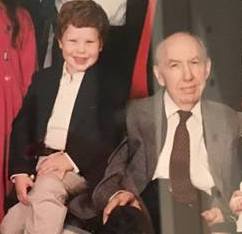

 Akiva Nechamtanu